AI-Driven Digital Transformation: A Practical Guide for Businesses
Artificial Intelligence (AI) is becoming an important part of modern business strategy, helping organizations analyze information, automate repetitive tasks, support employees, and improve operational processes. When implemented strategically, AI can help businesses use data more effectively, streamline workflows, and adapt to changing business needs.
However, successful Digital Transformation requires more than adopting new technology. Businesses must identify the right problems, evaluate their existing systems, and establish measurable objectives before implementing AI solutions. A well-planned approach to AI Development can help organizations align technology investments with their business goals.
This guide explains how businesses can use AI, where Business Automation can create opportunities for improvement, and how organizations can approach AI adoption through a practical implementation framework.
Where AI Can Support Digital Transformation
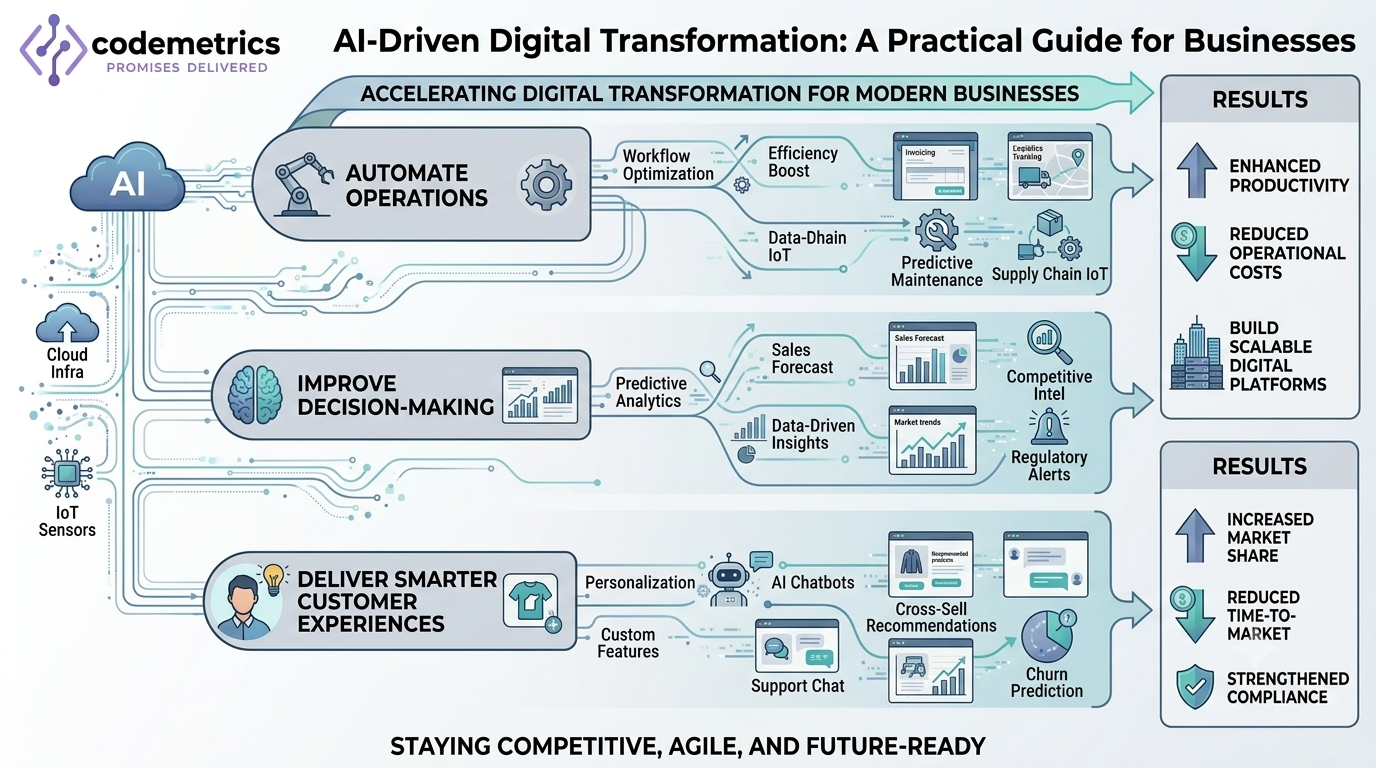
AI can support business improvements across customer service, operations, and data analysis. The right application depends on an organization's goals, available data, existing technology, and operational requirements.
Customer Experience
AI-powered chat assistants and customer support tools can help businesses answer frequently asked questions, categorize customer requests, and direct inquiries to the appropriate department. These tools can make routine interactions more manageable while allowing employees to focus on complex or sensitive issues.
For example, an online service business could introduce an AI-powered support assistant to explain its services, provide basic troubleshooting guidance, and direct account-specific questions to its support team. Human support should remain available when a request requires personal attention or specialist knowledge.
Businesses should evaluate such solutions using relevant measures, including response time, resolution rate, escalation frequency, and customer feedback. These indicators help determine whether the technology is delivering meaningful improvements.
Operations and Efficiency
Many business processes involve repetitive activities such as document classification, data entry, invoice processing, ticket routing, and report preparation. Appropriate automation tools can help reduce manual effort and make workflows more consistent.
For example, a finance team could use document-processing software to extract information from invoices and organize it for review. Employees would still verify important details before approving payments or updating financial records.
Effective Business Automation starts with understanding the existing process. Businesses should document processing time, error rates, approval requirements, and manual effort before implementing changes. This baseline makes it easier to evaluate the results objectively.
Data-Informed Decision-Making
Organizations collect information from customer interactions, sales activities, operational systems, and financial reports. AI tools can help summarize this information, identify unusual patterns, and generate forecasts to support business planning.
For example, a retail business could analyze historical sales data to identify seasonal demand patterns and support inventory planning. Managers should validate the underlying data and review AI-generated forecasts before making purchasing decisions.
AI-generated insights should support informed decisions rather than replace business expertise. Their reliability depends on data quality, appropriate model selection, and ongoing evaluation.
A Practical Framework for AI Adoption
A structured approach helps businesses evaluate opportunities, manage risks, and determine whether a solution delivers measurable value.
Phase 1: Assess the Business Problem
Begin by identifying a specific business challenge. Common examples include time-consuming administrative work, slow customer support, fragmented data, and difficulty preparing operational reports.
Discuss the problem with employees who understand the existing workflow. Document its causes, current limitations, and the outcome the proposed solution should achieve.
Establish measurable objectives before selecting a technology. Depending on the use case, these objectives could include reducing processing time, improving data accuracy, shortening response times, or reducing repetitive manual work.
A clearly defined problem provides a stronger starting point than selecting an AI tool simply because it is popular.
Phase 2: Select a Focused Pilot
Choose one manageable use case with accessible data, clear ownership, and limited operational risk. A focused pilot allows the organization to evaluate the proposed solution before committing to a larger implementation.
For example, a company could test AI-assisted document classification within one department before introducing the capability across multiple teams.
Before implementation, assess data readiness, privacy requirements, security controls, integration needs, and the possibility of inaccurate outputs. Establish who will review results and how errors will be handled.
The pilot should have a defined scope, an assigned owner, an estimated budget, and clear criteria for determining whether it should proceed to the next stage.
Phase 3: Measure and Improve
Once the pilot is operational, compare its performance against the baseline established before implementation. This evaluation helps distinguish measurable improvements from assumptions about the technology's potential.
Relevant performance indicators may include:
Average task completion time
Error and rework rates
Customer response and resolution times
Employee workload and productivity
Cost per completed task
User satisfaction and adoption rates
The appropriate metrics depend on the business problem. A document-processing solution, for example, may be evaluated primarily on extraction accuracy, processing time, and the amount of manual correction required.
Review results regularly, collect employee feedback, and investigate unexpected outputs. If the solution does not meet its objectives, refine the workflow, improve the data, or reconsider whether AI is the right approach.
Phase 4: Scale Responsibly
Expand the implementation only when the pilot demonstrates sufficient value and the organization can manage its associated risks.
Scaling may involve integrating the solution with additional applications, extending it to other departments, or supporting a larger volume of work. Each expansion should account for changes in data, user requirements, and operational complexity.
A successful Digital Transformation strategy also includes employee training, documented procedures, performance monitoring, maintenance, and clear responsibility for system performance.
Ongoing monitoring is important because business requirements, source data, and software systems can change over time. A responsible scaling strategy includes periodic reviews, incident handling, and a process for improving the solution when necessary.
Common Challenges to Consider
Although AI can create opportunities for improvement, implementation can introduce technical, operational, and organizational challenges. Identifying these challenges early helps businesses plan more effectively.
Data Quality and Availability
AI systems depend on the quality and suitability of their input data. Incomplete, outdated, inconsistent, or poorly organized information can lead to unreliable results.
Businesses should assess their data before implementation and establish appropriate processes for validation, access, and maintenance.
Integration with Existing Systems
A new AI solution may need to work with customer relationship management platforms, enterprise resource planning software, internal databases, and other business applications.
Integration requirements should be assessed during planning to reduce compatibility problems, unnecessary duplication, and disruption to existing workflows.
Privacy and Security
AI projects may involve confidential business information, employee records, or customer data. Organizations should determine which information the solution can access and establish appropriate security controls, permissions, and data-handling procedures.
Businesses should also evaluate third-party providers' security and data-use policies before sharing sensitive information.
Accuracy and Human Oversight
AI-generated content, summaries, classifications, and predictions may contain errors. The level of review should reflect the potential consequences of an incorrect output.
For example, an internal meeting summary may require limited verification, whereas financial or other high-impact decisions may require more rigorous review by qualified personnel.
Cost, Maintenance, and Employee Adoption
The cost of implementing AI extends beyond initial development or subscription fees. Businesses should consider integration, infrastructure, monitoring, employee training, maintenance, and future updates.
Employees also need to understand how new tools fit into their responsibilities. Clear guidance, practical training, and opportunities to provide feedback can help organizations introduce new technologies more effectively.
How Codemetrics Can Support Digital Transformation
Codemetrics Infotech Pvt. Ltd. provides software development and technology services that businesses can consider when planning digital solutions. Depending on project requirements, relevant areas may include custom software development, web application development, system integration, and AI-related development.
Businesses exploring AI Development should first define their objectives, existing technology environment, data requirements, security considerations, and expected outcomes. These factors help determine whether an AI-powered application, conventional software solution, workflow automation, or a combination of approaches is most suitable.
A structured development process can help organizations move from requirements gathering and solution planning to implementation, testing, and ongoing improvement.
For example, a business seeking to streamline an internal approval process could begin by mapping its current workflow, identifying repetitive tasks, and evaluating opportunities for automation. The final solution should be selected according to operational needs rather than assuming every process requires AI.
Codemetrics can be considered as a technology partner for businesses exploring software development and digital transformation opportunities. Project scope, feasibility, deliverables, and success criteria should be agreed upon before implementation begins.
Conclusion
Artificial Intelligence can support business improvement when it is applied to clearly defined problems and evaluated against meaningful objectives. Organizations can approach implementation more effectively by preparing suitable data, testing focused use cases, measuring outcomes, and expanding gradually when the evidence supports further investment.
A practical Digital Transformation roadmap should also account for privacy, security, integration, employee training, and ongoing maintenance. Rather than introducing AI into every business activity, organizations should choose technologies that address genuine operational needs.
With careful planning and a clear understanding of business requirements, companies can build a stronger foundation for sustainable growth. Combining the right technology with responsible implementation and continuous improvement can help businesses create long-term value through digital initiatives.