AI in Cloud Computing: Future of Smart Infrastructure
Cloud computing has transformed how businesses store data, run applications, and scale digital operations. Now, artificial intelligence is taking cloud technology to the next level by making infrastructure more intelligent, automated, predictive, and adaptive. The combination of AI and cloud computing is creating a new generation of smart infrastructure that can respond to business needs in real time.
What Is AI in Cloud Computing?
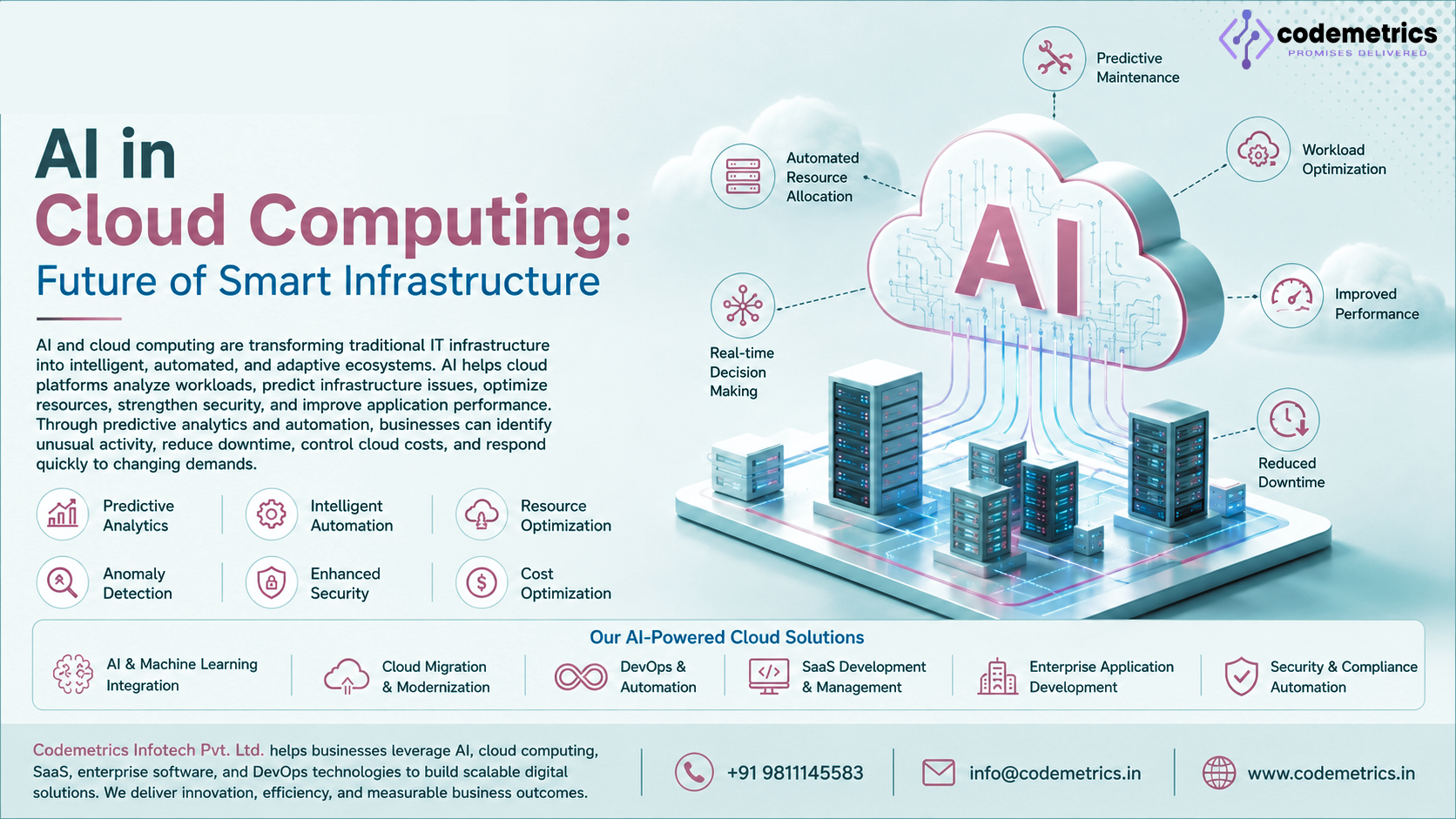
AI in Cloud Computing refers to the integration of artificial intelligence technologies such as machine learning, predictive analytics, natural language processing, and intelligent automation with cloud platforms. Instead of relying entirely on predefined rules and manual management, cloud infrastructure can analyze data, identify patterns, predict problems, and make intelligent decisions.
This approach allows organizations to optimize resources, improve application performance, strengthen security, and reduce operational costs. Cloud platforms can continuously learn from workloads and business activity, making infrastructure more responsive and efficient.
How AI Is Making Cloud Infrastructure Smarter
Traditional cloud environments require IT teams to monitor performance, allocate resources, identify threats, and resolve infrastructure issues. AI can automate many of these activities.
With AI Cloud Computing, organizations can use intelligent systems to analyze workloads and automatically adjust computing resources. For example, if application traffic suddenly increases, AI-driven infrastructure can identify the change and recommend or automatically initiate additional resources. When demand decreases, unnecessary resources can be reduced.
Predictive analytics can also identify potential system failures before they become serious problems. This helps organizations move from reactive maintenance to proactive infrastructure management.
Key Benefits of AI-Powered Cloud Infrastructure
1. Intelligent Automation
Automation is one of the biggest advantages of combining AI with cloud platforms. Routine activities such as resource allocation, workload management, monitoring, and optimization can be automated. This reduces manual intervention and allows IT teams to focus on strategic initiatives.
2. Better Resource Optimization
Cloud environments can sometimes consume more resources than necessary. AI can analyze usage patterns and identify opportunities to optimize infrastructure. Intelligent systems can help businesses determine when resources should be increased, reduced, or redistributed.
This can improve operational efficiency while helping organizations control cloud expenditure.
3. Predictive Maintenance
Unexpected downtime can negatively affect productivity and customer experience. AI can analyze infrastructure metrics, application behavior, and historical data to detect unusual patterns.
By identifying early warning signals, businesses can take preventive action before infrastructure failures occur. This predictive approach is becoming an important component of Intelligent Cloud Infrastructure.
4. Enhanced Cloud Security
Cybersecurity is another area where AI can provide significant value. AI-powered systems can continuously analyze network activity, user behavior, application logs, and other signals to identify suspicious patterns.
Machine learning models can help detect anomalies and potentially malicious activities faster than traditional monitoring approaches. When integrated with appropriate security controls, AI can support faster threat detection and response.
5. Improved Application Performance
Modern applications need to deliver fast and reliable experiences across different devices and locations. AI can monitor application performance and identify bottlenecks.
By analyzing real-time performance information, intelligent systems can recommend infrastructure changes and help organizations maintain consistent application availability.
AI and the Future of Smart Infrastructure
The future of cloud infrastructure will increasingly depend on systems that can understand their environment and respond automatically. AI-powered cloud platforms can evolve from simple infrastructure management tools into intelligent digital ecosystems.
For example, organizations may use AI to forecast demand, optimize workloads, detect security risks, automate operational decisions, and provide intelligent recommendations. This can create infrastructure that continuously adapts to changing business requirements.
AI-Powered Cloud Solutions are also expected to support advanced technologies such as Internet of Things devices, edge computing, autonomous systems, and real-time analytics. As organizations generate increasingly large volumes of data, intelligent cloud infrastructure will become essential for processing and interpreting that information efficiently.
Challenges Businesses Should Consider
Despite its benefits, implementing AI-driven cloud infrastructure requires careful planning. Organizations need high-quality data, appropriate AI models, skilled professionals, strong governance, and robust cybersecurity practices.
Data privacy is another important consideration, particularly for businesses handling financial, customer, healthcare, or confidential corporate information. Organizations should establish clear policies for data access, model usage, monitoring, and compliance.
Cost management is equally important. AI workloads can require significant computing resources, so businesses should evaluate workloads carefully and select suitable cloud architectures.
Conclusion
The convergence of AI and cloud computing is redefining modern IT infrastructure. AI enables cloud environments to become more predictive, automated, secure, and adaptable. From intelligent resource management and predictive maintenance to cybersecurity and application optimization, the possibilities are expanding rapidly.
As businesses continue their digital transformation journeys, adopting AI-driven infrastructure can provide the intelligence required to operate complex technology environments more efficiently. The future belongs to cloud ecosystems that do more than host applications—they understand workloads, anticipate requirements, and continuously optimize performance.
About Codemetrics Infotech Pvt. Ltd.
Codemetrics Infotech Pvt. Ltd. helps businesses adopt modern technologies through innovative software development and digital transformation solutions. Its expertise across AI, cloud computing, enterprise applications, SaaS, web development, and DevOps enables organizations to build scalable and intelligent technology ecosystems. By combining technical expertise with business-focused strategies, Codemetrics supports companies in modernizing infrastructure, automating operations, improving application performance, and preparing for future digital demands. Whether businesses need AI integration, cloud application development, enterprise software, or intelligent automation, Codemetrics Infotech Pvt. Ltd. focuses on delivering secure, scalable, and practical solutions aligned with organizational objectives.