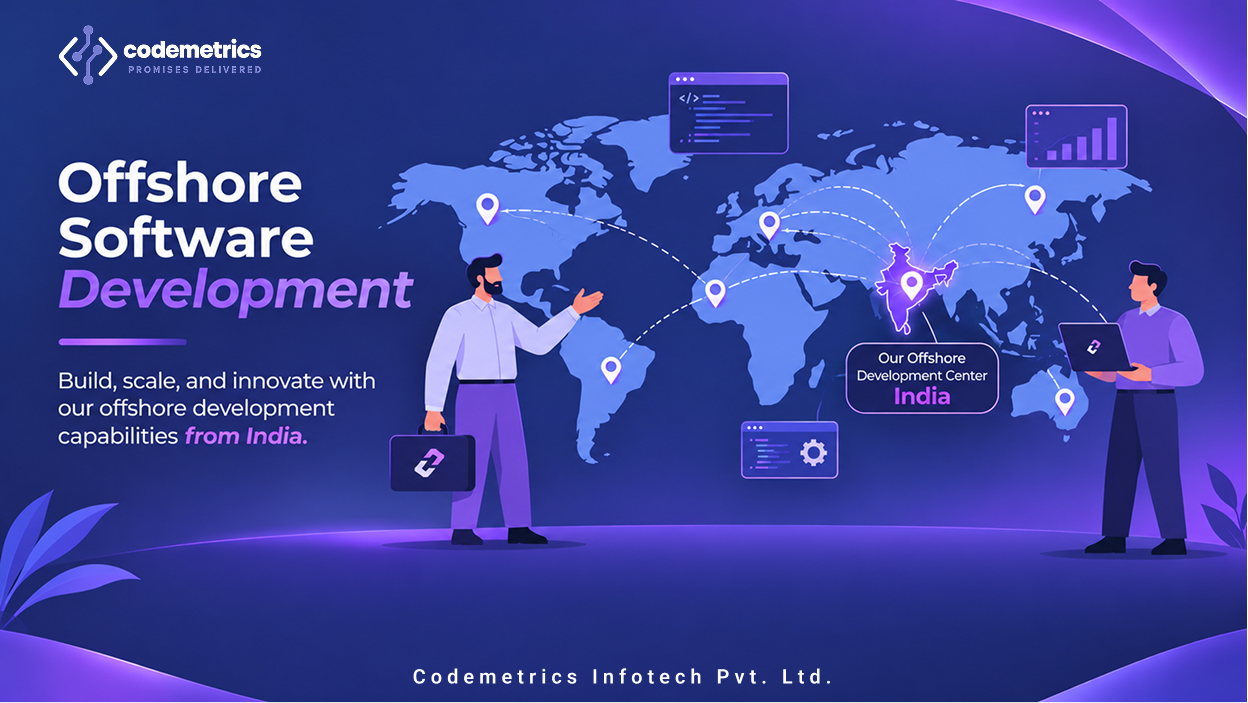
Offshore Software Development
As businesses increasingly depend on technology to operate, compete, and serve customers, software development has become a strategic priority. However, building and maintaining an in-house technology team can be expensive, time-consuming, and difficult to scale. Organizations need skilled developers, architects, testers, DevOps specialists, UI/UX professionals, and project managers while also keeping pace with rapidly changing technologies.
This is where offshore software development has become an important business strategy. Companies can work with specialized technology teams in other countries to access engineering talent, reduce development costs, accelerate delivery, and build products without expanding their internal workforce at the same rate.
A reliable Offshore Software Development Company can become an extension of an organization's technology team, providing specialized expertise while maintaining collaboration, security, and quality throughout the development lifecycle.
What Is Offshore Software Development?
Offshore software development refers to outsourcing software design, development, testing, maintenance, or related technology activities to a team located in another country or geographic region.
Instead of hiring every technology professional internally, a business can partner with an external development team that works according to its requirements, timelines, technology stack, and business objectives.
Offshore teams can support different types of projects, including:
Custom enterprise software
Web and mobile applications
SaaS platforms
Cloud-based applications
AI-powered solutions
API development and integrations
Legacy application modernization
Quality assurance and testing
DevOps and cloud infrastructure
The model is particularly useful for businesses that need additional engineering capacity without making a large long-term investment in internal hiring and infrastructure.
Why Businesses Are Choosing Offshore Development?
The technology talent market has become increasingly competitive. Finding experienced professionals in areas such as artificial intelligence, cloud computing, cybersecurity, DevOps, and modern application development can be challenging.
Offshore development gives businesses access to a wider talent pool. Instead of limiting recruitment to a local market, companies can work with developers and technology specialists from global locations.
Cost efficiency is another important factor. Offshore development can reduce expenses related to recruitment, office infrastructure, employee benefits, and technology operations. However, cost should not be the only consideration. The right partner should provide measurable value through technical expertise, reliable delivery, communication, and long-term support.
Access to Specialized Technology Expertise
Modern software projects often require multiple technical disciplines. A single product may need frontend developers, backend engineers, cloud architects, database specialists, QA engineers, DevOps professionals, and cybersecurity experts.
Building such a team internally can take months.
With an offshore model, organizations can assemble project-specific teams much faster. A business can access specialists according to the project's requirements rather than maintaining every skill permanently in-house.
For example, a company developing an AI-powered SaaS platform may need machine learning expertise during product development and additional cloud and DevOps support during deployment. An offshore team can scale these resources according to the project's changing requirements.
Offshore Software Development in India
India has become a major destination for global software development because of its large technology talent pool, strong engineering ecosystem, and experience working with international businesses.
An Offshore Software Development Company in India can provide development teams for startups, mid-sized companies, and enterprises looking to expand their technology capabilities.
Indian development teams commonly work with technologies such as React, Angular, Node.js, Python, Java, .NET, cloud platforms, mobile development frameworks, databases, DevOps tools, and AI technologies.
Another advantage is the availability of teams that can work across different time zones. With proper project management and communication processes, businesses can maintain continuous development cycles and faster issue resolution.
What Services Can Offshore Teams Provide?
The scope of Offshore Software Development Services can extend far beyond basic coding. A mature technology partner can participate in the complete software lifecycle.
This may include:
Product Discovery and Planning
Teams can analyze business requirements, define technical architecture, identify risks, and create a development roadmap before implementation begins.
Custom Software Development
Organizations can develop software tailored to their specific workflows rather than relying entirely on generic off-the-shelf products.
Web and Mobile Development
Offshore teams can design responsive web applications and mobile experiences for customers, employees, partners, and internal operations.
Cloud Development
Applications can be designed for cloud environments with scalability, availability, security, and performance in mind.
AI and Automation
Businesses can integrate AI-based search, recommendations, predictive analytics, document processing, chatbots, and workflow automation into their applications.
Testing and Quality Assurance
Automated and manual testing can help identify functional, performance, security, and usability issues before software reaches customers.
DevOps and Maintenance
Teams can support deployment automation, monitoring, infrastructure management, performance optimization, security updates, and ongoing maintenance.
How to Choose the Right Offshore Partner?
Choosing an Offshore Software Development Services Company requires more than comparing hourly rates.
Businesses should evaluate the partner's technical capabilities, communication processes, security standards, development methodology, previous experience, and ability to understand business requirements.
Before starting a project, organizations should clearly define:
Project scope
Development milestones
Technology stack
Communication process
Team structure
Security requirements
Intellectual property ownership
Testing standards
Maintenance responsibilities
Service-level expectations
A transparent development process reduces misunderstandings and creates accountability between the client and development team.
Communication and Time-Zone Management
One common concern with offshore development is communication. Different time zones, languages, and working cultures can create challenges if project communication is poorly managed.
The solution is not necessarily to avoid offshore teams. Instead, businesses should establish clear communication practices.
Regular video meetings, project management platforms, documentation, shared development environments, defined working hours, and overlapping time windows can keep teams aligned.
A strong offshore team should also provide regular progress updates and communicate technical risks early instead of waiting until a deadline approaches.
Security and Data Protection
Security should be a major consideration when outsourcing software development.
Organizations should evaluate how their technology partner handles source code, credentials, customer information, databases, development environments, and access permissions.
Security practices may include role-based access, encrypted communication, secure repositories, code reviews, vulnerability testing, backup procedures, and controlled production access.
Businesses handling sensitive customer or financial data should also ensure that their development partner understands applicable regulatory and compliance requirements.
Scaling Your Development Team
One of the biggest advantages of offshore development is flexibility.
A business may need five developers during the initial product phase, additional QA engineers before launch, and cloud specialists during expansion. Maintaining a large permanent team for every stage may not be practical.
An offshore model allows organizations to adjust team size according to project requirements. This can be particularly valuable for startups and growing businesses that need to control costs while continuing to build new products.
An Offshore Software Development Company can therefore act as a flexible extension of the internal technology organization rather than simply functioning as an external vendor.
The Future of Offshore Software Development
The future of offshore development will increasingly involve AI-assisted engineering, cloud-native development, automation, cybersecurity, and distributed product teams.
AI coding tools are improving developer productivity, while cloud platforms allow teams to collaborate on applications from virtually anywhere. At the same time, businesses are becoming more focused on measurable outcomes, security, intellectual property protection, and long-term product quality.
This means offshore partnerships are likely to evolve from simple outsourced coding arrangements into strategic technology relationships.
Companies will increasingly look for partners capable of contributing to architecture, product engineering, innovation, modernization, and continuous improvement.
Why Codemetrics Infotech Pvt. Ltd.?
Codemetrics Infotech Pvt. Ltd. helps businesses build and modernize digital products through custom software development, AI-powered applications, cloud solutions, SaaS platforms, web and mobile applications, and DevOps capabilities.
As an Offshore Software Development Services Company, Codemetrics focuses on understanding business requirements before selecting the right technology and development approach. Its teams can support businesses throughout the software lifecycle, from product planning and architecture to development, testing, deployment, and ongoing improvement.
For organizations looking for an Offshore Software Development Company in India, Codemetrics offers a flexible approach focused on scalable technology, transparent communication, quality engineering, and long-term business value.
Whether a business needs a new enterprise platform, a cloud application, an AI-powered product, or additional development capacity, Codemetrics can help transform technology requirements into reliable digital solutions.