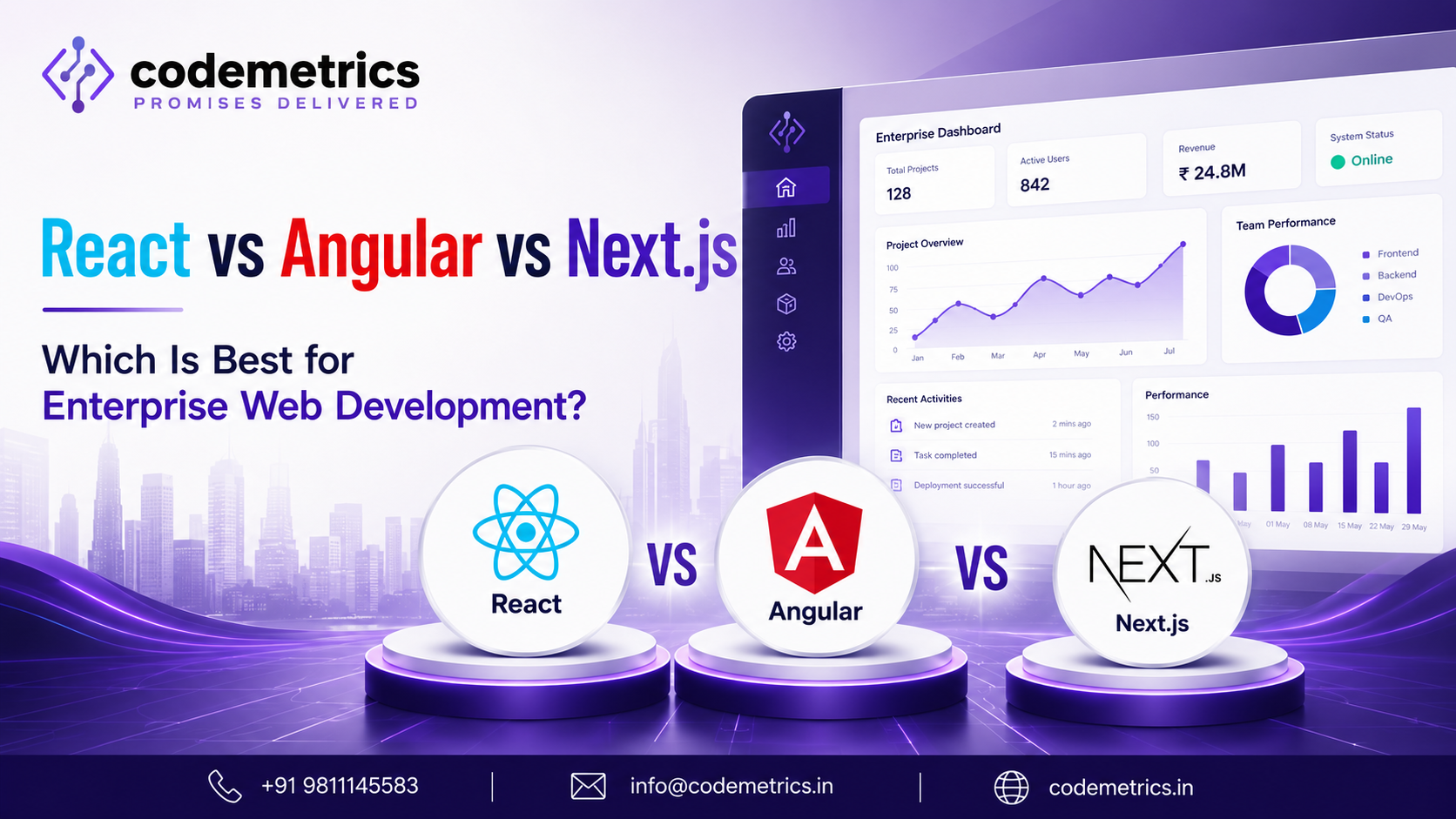
React vs Angular vs Next.js: Best Framework for Enterprise Web Development
Choosing the right technology for a large business application is more than a technical decision. It can affect development speed, scalability, performance, security, hiring, maintenance costs, and the ability to introduce new features. That is why enterprise web development requires a framework strategy based on business objectives rather than popularity alone.
React, Angular, and Next.js are three powerful choices for modern web applications. However, they solve different problems. React offers flexibility and a huge ecosystem, Angular provides a structured framework for complex applications, while Next.js extends React with modern rendering and full-stack capabilities. The right option depends on your application architecture, team expertise, SEO requirements, and long-term roadmap.
React: Flexibility for Complex Digital Products
React is technically a UI library rather than a complete application framework. Its component-based architecture allows development teams to create reusable interfaces and select additional tools for routing, state management, testing, and application architecture.
For businesses that need highly customized interfaces or already have React expertise, React can be an excellent foundation. Its large ecosystem also makes it easier to find developers and third-party solutions.
React enterprise development is particularly useful for interactive dashboards, customer portals, SaaS platforms, internal applications, and products where the development team wants greater architectural flexibility.
The trade-off is that enterprises need to make more architectural decisions themselves. Teams must establish consistent patterns for routing, state management, testing, security, and performance.
Angular: Structure for Large Enterprise Applications
Angular takes a different approach. It is a complete application framework built around TypeScript and provides many enterprise-oriented capabilities within a structured ecosystem.
For organizations with large development teams, complex workflows, strict coding standards, and long-term application lifecycles, Angular can provide valuable consistency. Its opinionated architecture can reduce disagreements about how different teams should structure applications.
Angular enterprise development can be a strong choice for banking platforms, administrative systems, business management applications, and other large applications where maintainability and standardized development practices are priorities.
Angular also provides a mature approach to dependency injection, routing, forms, and application organization, helping teams manage large codebases effectively.
Next.js: Modern React for Performance and Scalability
Next.js is a React framework that adds capabilities such as routing, server-side rendering, static generation, and modern server-oriented application patterns. This makes it particularly attractive for applications where performance, discoverability, and a streamlined development architecture matter.
Next.js development services are especially valuable for enterprise websites, eCommerce platforms, SaaS products, customer-facing portals, and applications that need strong SEO and fast initial page delivery.
Another advantage is that businesses can combine public-facing pages with interactive application areas within the same technology ecosystem. Next.js also provides a path toward server-rendered and hybrid applications rather than relying exclusively on client-side rendering.
React vs Angular vs Next.js: What Should Enterprises Choose?
There is no universal winner. The best technology depends on the application's requirements.
Requirement | React | Angular | Next.js |
|---|---|---|---|
Flexibility | Excellent | Moderate | Excellent |
Built-in structure | Moderate | Excellent | Strong |
SEO-focused applications | Good with additional architecture | Good | Excellent |
Large enterprise teams | Excellent | Excellent | Excellent |
Interactive dashboards | Excellent | Excellent | Excellent |
Public-facing applications | Excellent | Good | Excellent |
Full-stack capabilities | Requires additional tools | Requires backend architecture | Strong |
For organizations that prioritize flexibility and have experienced frontend teams, React can be an effective choice. For highly structured applications with large teams, Angular may be more appropriate. For modern customer-facing products where performance, SEO, and React-based development are important, Next.js can be a compelling option.
In practice, enterprise web development should begin with architecture rather than a framework. Teams should evaluate business requirements, existing systems, API architecture, security requirements, expected traffic, development resources, and future expansion before selecting a technology.
Performance, Scalability, and Maintenance
Enterprise applications need to remain reliable as traffic, data, and user expectations increase. Framework selection therefore needs to consider more than development speed.
React provides extensive flexibility for performance optimization, while Angular offers a structured environment for managing complex applications. Next.js adds multiple rendering approaches that can help teams optimize different parts of an application according to their requirements.
Long-term maintenance is equally important. A technology that is easy to build with but difficult to maintain can increase the total cost of ownership. Enterprises should establish coding standards, testing strategies, monitoring, documentation, security practices, and upgrade plans regardless of the selected framework.
How Codemetrics Helps Enterprises Choose the Right Technology
At Codemetrics Infotech Pvt. Ltd., we don't believe businesses should select a technology simply because it is trending. Our approach starts with understanding your business processes, users, existing technology stack, integration requirements, performance expectations, and growth plans.
Our team can help businesses evaluate React, Angular, and Next.js based on practical project requirements and then design an architecture that supports scalability, security, performance, and maintainability.
Whether you are building a new enterprise platform, modernizing an existing application, or migrating from a legacy technology stack, our goal is to turn technology decisions into measurable business outcomes.
For organizations planning enterprise web development, choosing the right partner can be just as important as choosing the right framework.
Ready to build your next enterprise application?
Connect with Codemetrics Infotech Pvt. Ltd. today.
📞 +91 9811145583
🌐 codemetrics.in
Promises Delivered.