DevOps
In today's fast-paced digital landscape, businesses are under constant pressure to deliver software faster, maintain high-quality standards, and adapt quickly to changing customer demands. Cloud computing has transformed the way applications are built and deployed, but managing cloud environments efficiently requires a modern development approach. This is where DevOps in Cloud Application Development plays a critical role.
DevOps bridges the gap between development and operations teams, enabling organizations to create, test, deploy, and manage applications more efficiently. By combining automation, collaboration, and continuous monitoring, DevOps helps businesses maximize the benefits of cloud technologies while accelerating innovation.
Understanding DevOps in Cloud Environments
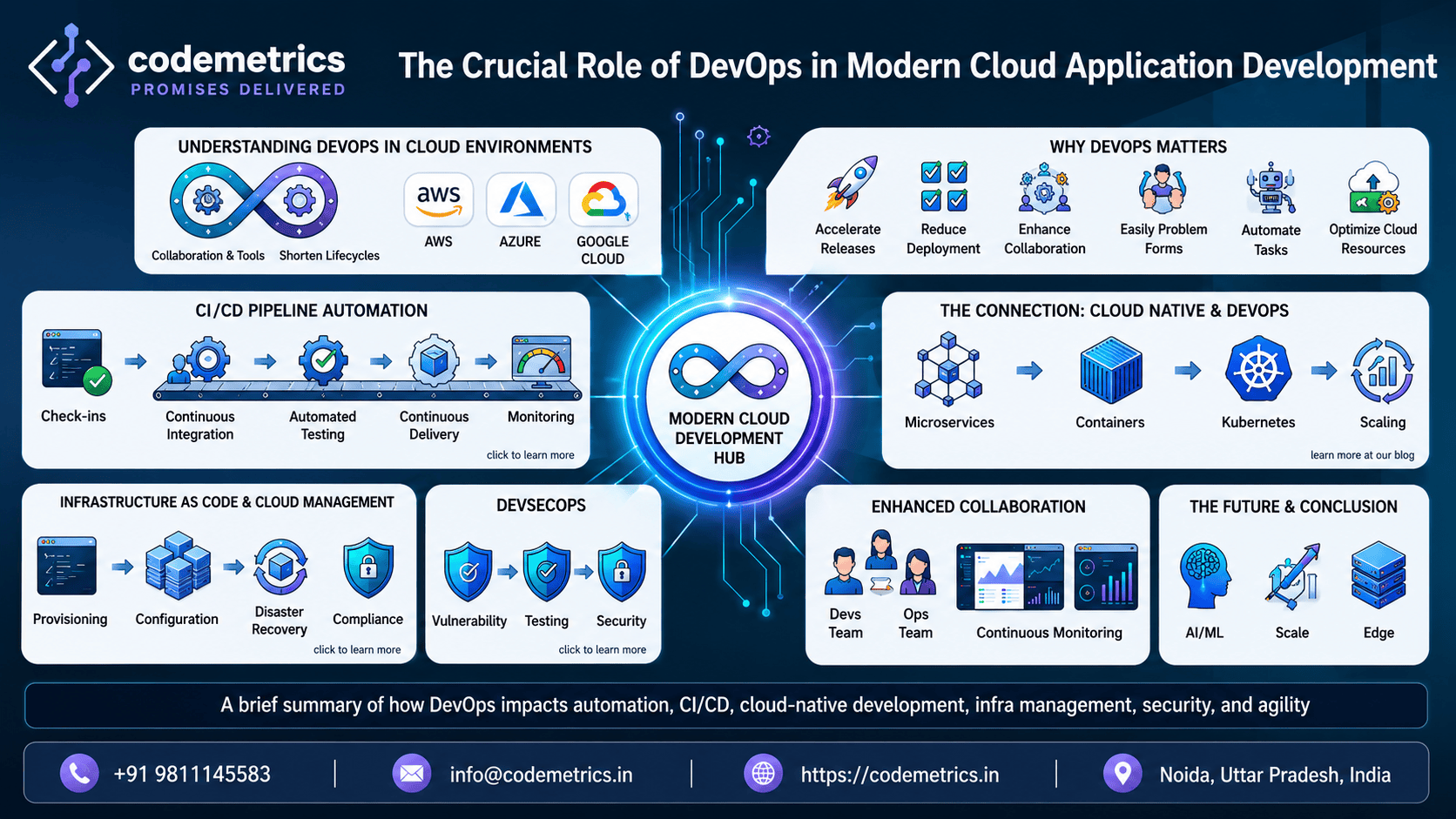
DevOps is a set of practices, tools, and cultural philosophies that improve collaboration between software development and IT operations teams. The primary goal is to shorten the software development lifecycle while delivering reliable applications at high speed.
With the rise of cloud platforms such as AWS, Azure, and Google Cloud, organizations are increasingly adopting DevOps in Cloud Application Development to streamline workflows and automate infrastructure management. This approach ensures faster deployments, improved scalability, and enhanced application performance.
Why DevOps Matters for Modern Cloud Applications
Modern cloud applications are highly dynamic and often consist of multiple microservices, APIs, and distributed systems. Managing these components manually can be complex and time-consuming.
DevOps helps organizations:
Accelerate software releases
Improve system reliability
Reduce deployment errors
Enhance collaboration across teams
Automate repetitive tasks
Optimize cloud resource utilization
These benefits enable businesses to remain competitive while delivering better customer experiences.
The Connection Between Cloud Native Development and DevOps
One of the biggest drivers behind DevOps adoption is the growth of Cloud Native Development. Cloud-native applications are designed specifically for cloud environments, utilizing technologies such as containers, microservices, and Kubernetes.
DevOps practices complement cloud-native architectures by providing automated deployment, monitoring, and scaling capabilities. Development teams can continuously improve applications without causing disruptions to end users.
As organizations increasingly embrace Cloud Native Development, DevOps becomes essential for maintaining agility and ensuring consistent performance across cloud environments.
CI/CD Pipeline Automation: The Backbone of DevOps
Continuous Integration and Continuous Delivery (CI/CD) are fundamental components of DevOps. Through CI/CD Pipeline Automation, code changes are automatically tested, integrated, and deployed to production environments.
Benefits of automated CI/CD pipelines include:
Faster software releases
Reduced human errors
Improved code quality
Faster bug detection
Consistent deployment processes
Organizations implementing CI/CD Pipeline Automation can deploy updates multiple times a day while maintaining application stability and security. This capability is especially important in cloud environments where rapid innovation is required.
Infrastructure as Code and Cloud Management
Traditional infrastructure management often relies on manual configuration, which can lead to inconsistencies and operational risks. DevOps addresses this challenge through Infrastructure as Code (IaC), allowing teams to manage infrastructure using code and automation tools.
This approach significantly improves Cloud Infrastructure Management by enabling:
Automated server provisioning
Consistent environment configurations
Faster disaster recovery
Better compliance and governance
Reduced operational overhead
Effective Cloud Infrastructure Management ensures that cloud resources remain scalable, secure, and cost-efficient while supporting business growth.
Enhanced Collaboration Across Teams
One of the most important aspects of DevOps is its cultural impact. Historically, development and operations teams worked in separate silos, leading to communication gaps and delays.
DevOps encourages shared responsibility, transparency, and collaboration. Teams work together throughout the entire software lifecycle, from planning and development to deployment and monitoring.
This collaborative approach leads to:
Faster problem resolution
Better knowledge sharing
Increased productivity
Improved customer satisfaction
As cloud applications become more complex, strong collaboration becomes essential for maintaining operational excellence.
Improved Security Through DevSecOps
Security is a major concern in cloud application development. Modern DevOps practices integrate security throughout the development process, often referred to as DevSecOps.
By embedding security checks into CI/CD pipelines, organizations can:
Detect vulnerabilities early
Automate security testing
Maintain regulatory compliance
Reduce security risks
Strengthen application resilience
This proactive security approach helps organizations protect sensitive data while maintaining development speed.
Continuous Monitoring and Performance Optimization
Cloud applications require constant monitoring to ensure availability and performance. DevOps teams use advanced monitoring tools to collect real-time insights into application behavior, infrastructure health, and user experience.
Continuous monitoring enables organizations to:
Identify issues before they impact users
Optimize cloud resource utilization
Improve application performance
Reduce downtime
Support data-driven decision-making
This visibility helps businesses deliver reliable digital experiences while controlling operational costs.
The Future of DevOps in Cloud Application Development
As cloud technologies continue to evolve, DevOps will remain a key enabler of digital transformation. Emerging technologies such as artificial intelligence, machine learning, and edge computing are further expanding the role of DevOps.
Organizations that invest in DevOps in Cloud Application Development will be better positioned to innovate rapidly, improve customer experiences, and scale efficiently in increasingly competitive markets.
Conclusion
Modern businesses need agile, scalable, and secure cloud applications to stay ahead in today's digital economy. DevOps provides the framework required to automate workflows, improve collaboration, enhance security, and accelerate software delivery. By combining cloud technologies with DevOps best practices, organizations can achieve greater operational efficiency and faster innovation.
At Codemetrics Infotech Pvt. Ltd., we help businesses leverage the power of cloud technologies and DevOps to build future-ready digital solutions. Our team specializes in cloud-native architectures, automation strategies, CI/CD implementation, infrastructure optimization, and enterprise software development. Whether you're modernizing existing systems or building new cloud applications, Codemetrics delivers scalable, secure, and high-performance solutions tailored to your business objectives, helping organizations accelerate digital transformation and achieve sustainable growth in a competitive market.