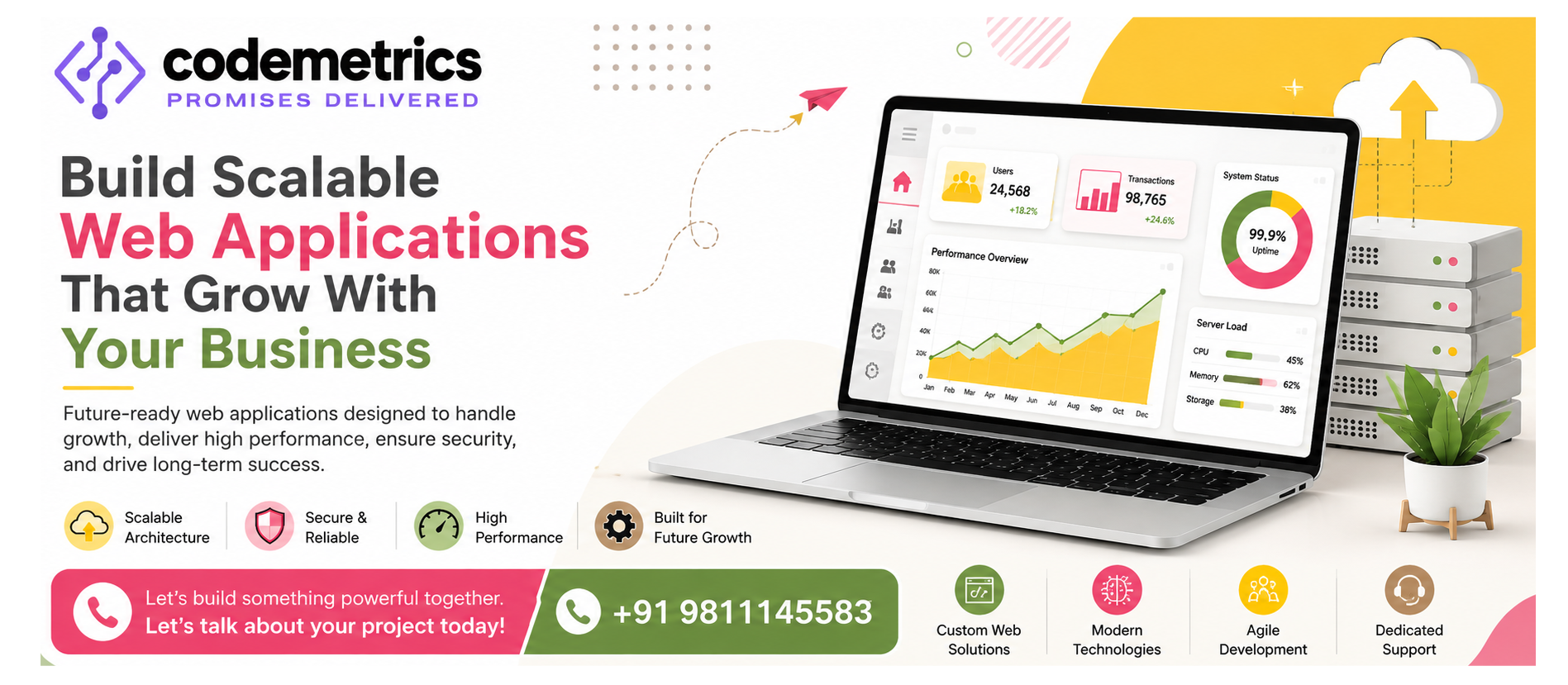
Scalable Web Applications
Businesses are no longer competing only on products and prices. In 2026, digital performance, customer experience, automation, and the ability to respond quickly to changing market demands are becoming critical factors for business success. As customer traffic, data volumes, integrations, and digital services continue to grow, businesses need technology that can grow with them.
This is where scalable web applications become essential.
A scalable web application is designed to handle increasing users, transactions, data, and business operations without compromising performance, security, or reliability. Whether you are building an e-commerce platform, SaaS product, enterprise portal, financial application, or customer management system, scalability helps ensure that your application remains efficient as your business expands.
What Are Scalable Web Applications?
A scalable web application is a web-based software solution designed to accommodate business growth. It can support increasing numbers of users, requests, transactions, and data without requiring a complete redesign of the application.
Unlike applications built only for current requirements, scalable applications are developed with future growth in mind. They can expand their infrastructure, functionality, and capacity as business demands increase.
For example, an e-commerce business may initially receive a few thousand visitors per month. As marketing campaigns and customer adoption increase, traffic could grow to hundreds of thousands of visitors. A scalable application can accommodate this growth by using technologies such as cloud computing, caching, load balancing, APIs, databases, microservices, and containerization.
Why Businesses Need Scalable Web Applications in 2026
1. Handle Growing User Traffic
Business growth often brings increased website and application traffic. A solution that performs well with 1,000 users may struggle when thousands or millions of users access it simultaneously.
Scalable web application development allows businesses to prepare for traffic growth. Cloud infrastructure, load balancing, caching, and optimized databases can distribute workloads and help applications remain responsive during traffic spikes.
This is particularly important for e-commerce platforms, online education systems, SaaS applications, marketplaces, and financial platforms.
2. Improve Application Performance
Users expect digital platforms to be fast, responsive, and reliable. Slow-loading pages, application errors, or downtime can negatively affect customer satisfaction and conversions.
Scalable software solutions are designed to maintain performance as workloads increase. Developers can optimize databases, APIs, application architecture, content delivery, and infrastructure to deliver a consistent user experience.
Better performance can also support stronger customer retention and business growth.
3. Support Business Expansion
Businesses rarely remain the same size or operate with the same requirements for years.
A company may expand into new markets, introduce new products, increase its customer base, or add new business processes. A scalable application makes these changes easier to manage.
Instead of replacing an existing system every few years, businesses can enhance their applications by adding new features, integrations, modules, and infrastructure.
This makes scalability a long-term technology investment rather than simply a technical requirement.
4. Reduce Long-Term Development Costs
Building an application without scalability in mind can create technical debt. As the business grows, developers may need to rewrite major parts of the application to accommodate new requirements.
A well-planned architecture can reduce these risks.
With custom web application development, businesses can create an architecture based on their current requirements while keeping future expansion in mind. Modular architecture, reusable components, APIs, and cloud-based infrastructure can make future development more efficient.
Although scalable development may require more planning initially, it can help reduce expensive redevelopment later.
5. Deliver Better Customer Experiences
Customer expectations continue to rise. People want applications that are fast, accessible, reliable, and easy to use across devices.
A scalable web application helps businesses maintain consistent performance as customer demand increases.
For example, an online retailer must be able to handle large numbers of customers during seasonal promotions. Similarly, an education platform must be capable of supporting large numbers of students accessing courses, assignments, and assessments simultaneously.
Reliable digital experiences can directly contribute to customer satisfaction and business reputation.
6. Enable AI and Modern Digital Integrations
AI is becoming increasingly integrated into modern business applications. Companies are using AI for recommendations, customer support, document processing, fraud detection, analytics, automation, and personalization.
Scalable applications make it easier to integrate AI services, APIs, cloud platforms, analytics tools, payment gateways, CRM systems, ERP platforms, and other third-party services.
A flexible architecture also allows businesses to adopt emerging technologies without rebuilding their entire application.
7. Strengthen Security and Reliability
As applications grow, they often process more users, transactions, and sensitive information. Security therefore needs to be considered as part of the application's architecture.
Modern scalable web applications can incorporate authentication, authorization, encryption, secure APIs, monitoring, automated backups, access controls, and other security measures.
For businesses operating in industries such as FinTech, healthcare, education, and e-commerce, building security and reliability into the application from the beginning is especially important.
Key Features of a Scalable Web Application
A scalable web application typically includes several architectural and technical capabilities:
Cloud-ready infrastructure for flexible resource allocation
Load balancing to distribute traffic across servers
Caching to reduce response times and server workloads
Optimized databases for handling growing data volumes
API-driven architecture for integrations and interoperability
Modular architecture for easier feature development
Microservices, where appropriate, to independently scale application components
Containerization using technologies such as Docker
Container orchestration using platforms such as Kubernetes
Monitoring and logging to identify performance and operational issues
Automated deployment to support faster and safer releases
The right architecture depends on the application's requirements. Not every business needs a complex microservices environment. A good development strategy focuses on practical scalability rather than unnecessary technical complexity.
Scalable Web Applications vs. Traditional Web Applications
Traditional applications may be designed primarily around current business requirements. When traffic or functionality increases significantly, these applications can experience performance problems and become difficult to maintain.
Scalable applications, on the other hand, are designed with growth in mind.
Traditional Application | Scalable Web Application |
|---|---|
Designed mainly for current requirements | Designed for current and future growth |
Limited capacity expansion | Flexible capacity expansion |
Scaling may require major changes | Scaling can be planned into the architecture |
Limited integration flexibility | API and integration ready |
Higher risk of technical debt | Better long-term maintainability |
May struggle with traffic spikes | Designed to handle changing workloads |
Technologies Behind Scalable Web Application Development
Modern web application development services use a combination of technologies depending on business requirements.
Frontend frameworks such as React, Next.js, and TypeScript can help create modern and maintainable user interfaces. Backend technologies such as Node.js, .NET, and Python can support robust business logic and APIs.
Cloud platforms such as AWS and Microsoft Azure can provide flexible infrastructure and computing resources. Docker and Kubernetes can support containerized applications and deployment at scale.
However, technology selection should always follow business requirements. The objective is not simply to use the newest technology but to build an architecture that is reliable, maintainable, secure, and capable of supporting growth.
Industries That Benefit from Scalable Web Applications
Almost every digitally enabled industry can benefit from scalable applications.
E-commerce
E-commerce platforms need to handle product catalogs, customer accounts, payments, orders, promotions, and traffic spikes.
FinTech
Financial platforms require secure, reliable, high-performance systems capable of handling large transaction volumes.
EdTech
Education platforms need to support students, instructors, online courses, assessments, video content, and large concurrent user volumes.
Logistics and Supply Chain
Logistics applications can connect orders, inventory, warehouses, vehicles, customers, and real-time tracking systems.
SaaS
SaaS businesses need infrastructure that can support a growing number of customers while maintaining consistent performance and availability.
Enterprise
Large organizations often require scalable internal platforms for CRM, HR, finance, operations, analytics, and workflow automation.
How Businesses Can Build a Future-Ready Web Application
Businesses should begin with a clear understanding of their current requirements and expected future growth. Before development begins, teams should evaluate expected traffic, data volumes, integrations, security requirements, user roles, business processes, and potential expansion.
A strong approach includes:
Define current and future business requirements.
Select an appropriate application architecture.
Design APIs and integrations carefully.
Optimize database structure and queries.
Use cloud infrastructure where appropriate.
Implement security from the beginning.
Monitor application performance continuously.
Automate testing and deployment.
Plan for disaster recovery and backups.
Review and optimize the application as the business grows.
Why Choose Codemetrics for Scalable Web Application Development?
At Codemetrics Infotech Pvt. Ltd., we help businesses build modern, scalable, and secure software solutions designed around their specific business objectives.Our scalable web application development approach combines modern technologies, cloud capabilities, robust architecture, API integrations, security practices, and performance optimization to create applications that can evolve with your business.Whether you need an enterprise platform, SaaS application, e-commerce solution, customer portal, workflow automation system, or AI-enabled web application, our team can help transform your requirements into a practical digital solution.
Conclusion
In 2026, businesses need more than a web application that works today. They need digital platforms that can adapt to tomorrow's users, technologies, integrations, and business opportunities.
Scalable web applications provide the foundation businesses need to manage growth while maintaining performance, security, reliability, and customer experience. By investing in scalable architecture from the beginning, organizations can reduce technical limitations, support innovation, and build a stronger foundation for long-term digital transformation.
If your business is planning a new web application or needs to modernize an existing platform, choosing the right web application development company can make a significant difference.
Ready to build a scalable digital solution for your business? Contact Codemetrics Infotech Pvt. Ltd. to discuss your web application development requirements.