Introduction
In today's digital-first marketplace, your website is often the first interaction a potential customer has with your business. If your website looks excellent on a desktop but is difficult to navigate on a smartphone, you could be losing valuable leads before they ever contact you.
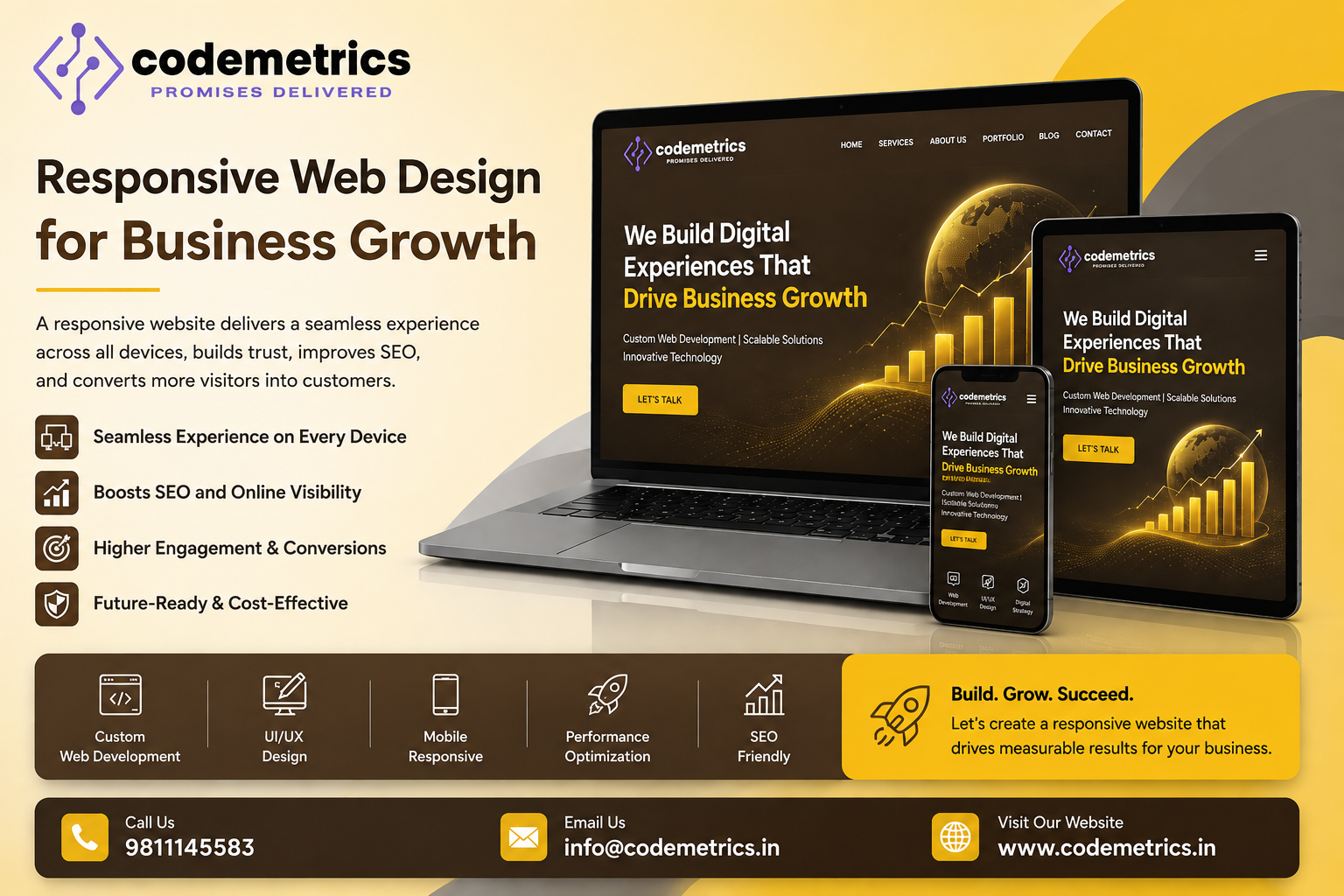
That is why responsive web design has become an essential business investment rather than simply a visual enhancement. A responsive website automatically adapts its layout, images, navigation, content, and functionality to different screen sizes, including smartphones, tablets, laptops, and desktops.
Recent industry discussions continue to highlight the importance of mobile usability, SEO, performance, and conversion-focused design.
What Is Responsive Web Design?
Responsive design creates a flexible website experience that adjusts according to the visitor's device and screen size. Instead of developing completely separate desktop and mobile websites, businesses can maintain one website that delivers a consistent experience across devices.
For customers, this means readable content, easy navigation, properly sized buttons, optimized images, and smooth interactions. For businesses, it means a more manageable digital platform that can support marketing, SEO, lead generation, and long-term growth.
A strong responsive website design also helps maintain brand consistency. Customers should recognize your business whether they discover you through a smartphone search, visit your website from a laptop, or return later using a tablet.
1. Reach More Customers on Every Device
Mobile devices have become a major source of web traffic worldwide. Current 2026 industry reporting indicates that mobile represents more than half of global web traffic, making mobile usability a critical part of the customer journey.
If visitors need to zoom, scroll horizontally, or struggle to find your contact button, they may simply leave.
With mobile responsive web design, your website adapts to the visitor instead of forcing the visitor to adapt to your website. This creates a smoother experience and gives potential customers more reasons to explore your products or services.
2. Improve User Experience and Build Trust
A professional website should make it easy for visitors to understand who you are, what you offer, and what action they should take next.
Responsive layouts help businesses create clear navigation, readable typography, accessible forms, and touch-friendly interfaces. When customers can interact with your website effortlessly, your brand appears more professional and trustworthy.
Good UX can also reduce friction between discovering your business and submitting an enquiry, requesting a quotation, booking a consultation, or making a purchase.
3. Support SEO and Online Visibility
Search engines increasingly evaluate websites through the experience delivered to users, particularly on mobile devices. Responsive architecture also provides a single website and URL structure, making content and technical SEO management simpler.
This is where responsive website design becomes valuable beyond aesthetics. A properly developed site can support mobile usability, performance optimization, crawlability, and consistent content delivery.
However, responsive design alone does not guarantee rankings. Businesses still need quality content, technical SEO, structured data, strong internal linking, fast performance, and a well-planned search strategy.
4. Increase Lead Generation and Conversions
Your website ultimately needs to contribute to business results.
A beautiful website that generates no enquiries is not enough. Every important page should guide visitors toward a meaningful action. Responsive layouts make calls-to-action, contact forms, service pages, product information, and navigation easier to use across devices.
For example, a potential client searching for software development services from a smartphone should be able to immediately understand your expertise and contact your sales team without struggling with the interface.
This is why mobile responsive web design should be treated as part of your conversion strategy—not simply a design requirement.
5. Reduce Long-Term Development and Maintenance Costs
Maintaining separate desktop and mobile websites can increase development complexity and maintenance requirements. A responsive website uses a unified approach that adapts to different screen sizes.
This makes it easier for businesses to update content, implement SEO improvements, maintain branding, and introduce new features.
It also creates a stronger foundation for future devices and screen sizes without requiring a completely new website every time user technology changes.
Why Choose CodeMetrics Infotech?
At CodeMetrics Infotech Pvt. Ltd., we build websites with business objectives in mind—not just attractive interfaces.
Our responsive web design services combine modern UI/UX principles, responsive development, performance optimization, SEO-friendly architecture, and conversion-focused experiences.
Whether you need a corporate website, enterprise platform, eCommerce solution, SaaS product, or custom web application, our team can create a scalable digital experience designed around your business goals.
Our approach focuses on:
Mobile-first and responsive development
Conversion-focused UI/UX
SEO-friendly website architecture
Performance and speed optimization
Scalable technology solutions
Secure and maintainable development
Ongoing website support
Turn Your Website Into a Growth Engine
Your website should do more than represent your company online. It should attract visitors, build credibility, generate enquiries, and support revenue growth.
If your current website is outdated, slow, difficult to use on mobile, or failing to generate enough leads, it may be time for a strategic upgrade.
CodeMetrics Infotech provides professional responsive web design services to help businesses build modern, scalable, and conversion-focused digital experiences.
Ready to build a website that works for your business on every device?
📞 Call CodeMetrics Infotech Pvt. Ltd. at 9811145583 and discuss your website requirements with our team.