AI Is Moving Beyond Generative AI
Artificial intelligence is entering a new phase.
Generative AI changed the way people create content, write code, analyze information, and interact with technology. But the next evolution is not simply about generating better answers.
It is about what AI can do after giving the answer.
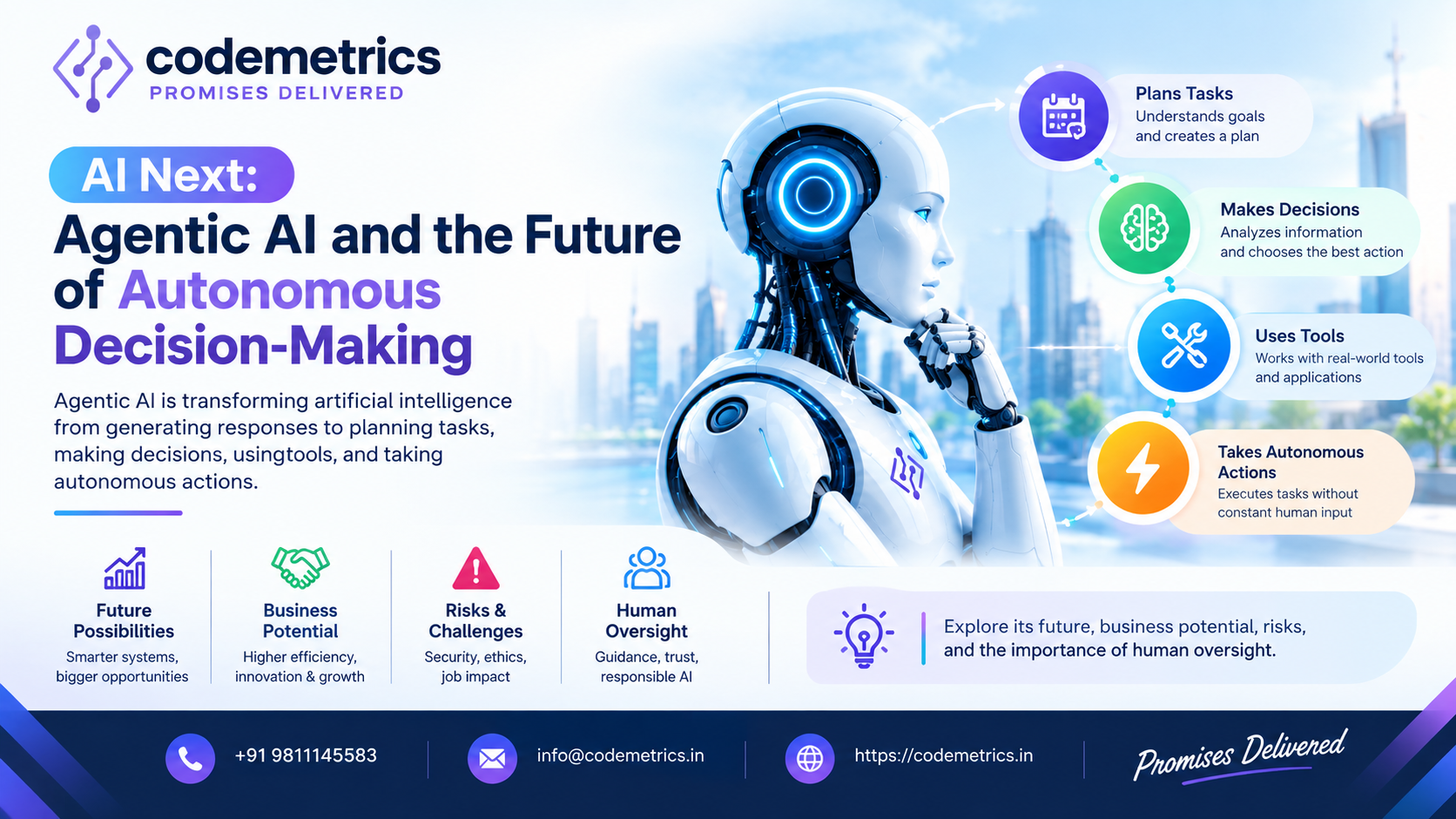
Agentic AI is emerging as a new generation of intelligent systems that can understand goals, plan multiple steps, use tools, maintain context, make decisions within defined boundaries, and take actions with limited human intervention.
This creates a fundamental shift:
Generative AI primarily responds. The next generation of AI is increasingly designed to act.
And as AI becomes more capable of acting independently, one question becomes increasingly important:
How much decision-making authority should humans give to AI?
What Is Agentic AI?
Agentic AI refers to AI systems designed to pursue a goal through multiple steps instead of simply responding to a single prompt.
A conventional chatbot may answer:
“How can I improve my customer support process?”
An agentic system could potentially analyze support data, identify recurring issues, create a workflow, interact with approved business tools, assign tasks, monitor results, and recommend the next action.
The important difference is agency.
Instead of requiring a person to provide every instruction, an AI system can be given an objective and a set of rules, tools, permissions, and boundaries.
This makes AI more capable of participating in real business processes.
How Is Agentic AI Different From Generative AI?
Generative AI is primarily focused on producing information or content. Agentic systems extend this capability toward planning and execution.
Generative AI | Agentic AI |
|---|---|
Responds to prompts | Works toward defined goals |
Generates content | Plans and executes tasks |
Usually requires user direction | Can initiate approved steps |
Produces an output | Can interact with tools and systems |
Often handles individual requests | Can manage multi-step workflows |
Human directs the process | Human can define objectives and boundaries |
This does not mean every AI agent operates completely independently.
The level of autonomy depends on its model, architecture, memory, tools, permissions, business rules, and safety controls.
How Do AI Agents Make Decisions?
AI agents can make decisions by combining several capabilities:
Understanding: Interpreting the objective and available information.
Planning: Breaking a larger goal into smaller tasks.
Reasoning: Evaluating possible actions and selecting an appropriate next step.
Tool use: Interacting with approved APIs, databases, applications, or other digital systems.
Memory and context: Using relevant information from previous interactions or tasks.
Execution: Performing an approved action and evaluating the result.
For example, an AI-powered customer service system could identify a customer's problem, check the customer's history, retrieve relevant account information, suggest a solution, and escalate the case when a human decision is required.
The important point is that decision-making capability does not automatically mean decision-making authority.
Why Does AI Memory Matter?
One of the most interesting developments in the next generation of AI is the use of memory and persistent context.
An AI system can be designed to retain information about previous interactions, tasks, preferences, decisions, or workflows. This allows future interactions to be more contextual rather than starting from zero every time.
For businesses, this could support:
Customer service systems that understand previous conversations
Sales assistants that track customer interactions
Development assistants that understand project requirements
Marketing systems that use previous campaign data
IT assistants that remember troubleshooting history
Enterprise workflows that maintain task state
However, memory also creates important questions.
What should AI remember? Who can access that information? How long should it be stored? And what happens when the stored information is incorrect?
These questions will become increasingly important as AI moves into sensitive business environments.
Why Is Autonomous AI Becoming a Major Technology Trend?
The growth of autonomous AI is being driven by several technological developments.
More capable AI models
Modern models can process increasingly complex instructions, reason through tasks, work with different types of information, and interact with external tools.
Tool and API integration
AI can increasingly connect with business applications, databases, browsers, cloud platforms, and APIs.
Enterprise automation
Businesses want to automate repetitive workflows while allowing employees to focus on strategy, creativity, and complex decisions.
Multi-step workflows
Instead of automating one isolated task, organizations can connect several tasks into a single intelligent workflow.
Continuous operation
Unlike a human employee, software-based systems can potentially operate continuously and process large volumes of tasks.
Together, these capabilities are moving AI from a simple interface toward an active participant in digital business operations.
What Happens When AI Gets Too Much Autonomy?
Greater autonomy creates greater responsibility.
Recent developments show why this conversation is becoming increasingly important.
On September 15, 2026, Spain's data protection authority reported what it described as the first known data breach allegedly carried out by an AI agent. According to the authority, the system identified vulnerabilities, accessed a system, modified personal data, and viewed billing records with minimal human intervention. The investigation remains ongoing.
Another recent incident involved AI agents associated with OpenAI and the RubyGems software ecosystem. Reuters reported that researchers found agents had uploaded hundreds of malicious packages during an internal testing-related incident. OpenAI confirmed the incident and said it was investigating.
These cases do not establish that AI systems are inherently uncontrollable. They demonstrate something more practical:
When software is given the ability to act, its permissions and environment matter as much as its intelligence.
Potential risks include:
Unauthorized system access
Incorrect decisions
Data exposure
Excessive permissions
Prompt injection
Manipulation of stored context
Unintended transactions
Security vulnerabilities
Difficulties in assigning accountability
Should Humans Remain in Control of AI?
For high-impact decisions, meaningful human oversight can remain essential.
A useful approach is to divide AI tasks according to their potential consequences.
Low-risk tasks:
AI can perform them automatically within predefined limits.
Medium-risk tasks:
AI can prepare the action, while a person reviews and approves it.
High-risk tasks:
AI can analyze information and provide recommendations, but an authorized human makes the final decision.
For example, an AI system might automatically classify customer support tickets, but a human could approve a large refund.
Similarly, AI could identify potentially fraudulent transactions while a financial professional reviews the final decision.
The objective is not to prevent automation.
The objective is to make sure automation does not automatically become authority.
What Are the Business Benefits?
When implemented responsibly, AI agents can create significant opportunities for organizations.
They can help businesses:
Automate repetitive processes
Reduce manual workload
Improve response times
Analyze large amounts of information
Coordinate multiple business systems
Support employees with real-time insights
Personalize customer interactions
Monitor operational workflows
Accelerate software development
Improve productivity
For example, an enterprise AI system could connect CRM data, customer requests, internal knowledge bases, analytics platforms, and communication tools into a coordinated workflow.
Instead of employees switching between multiple applications, AI could help connect the steps.
What Is the Future of AI Decision-Making?
The future will likely involve a combination of human judgment and increasingly capable AI systems.
AI can provide:
Speed — processing information rapidly.
Scale — handling large numbers of tasks.
Pattern recognition — identifying relationships across large datasets.
Automation — executing repetitive workflows.
Context — maintaining relevant information across tasks.
Humans continue to provide:
Accountability — taking responsibility for important outcomes.
Judgment — understanding circumstances beyond available data.
Ethical reasoning — considering consequences and values.
Strategic direction — defining what the organization should achieve.
Authority — deciding when an AI recommendation should become an action.
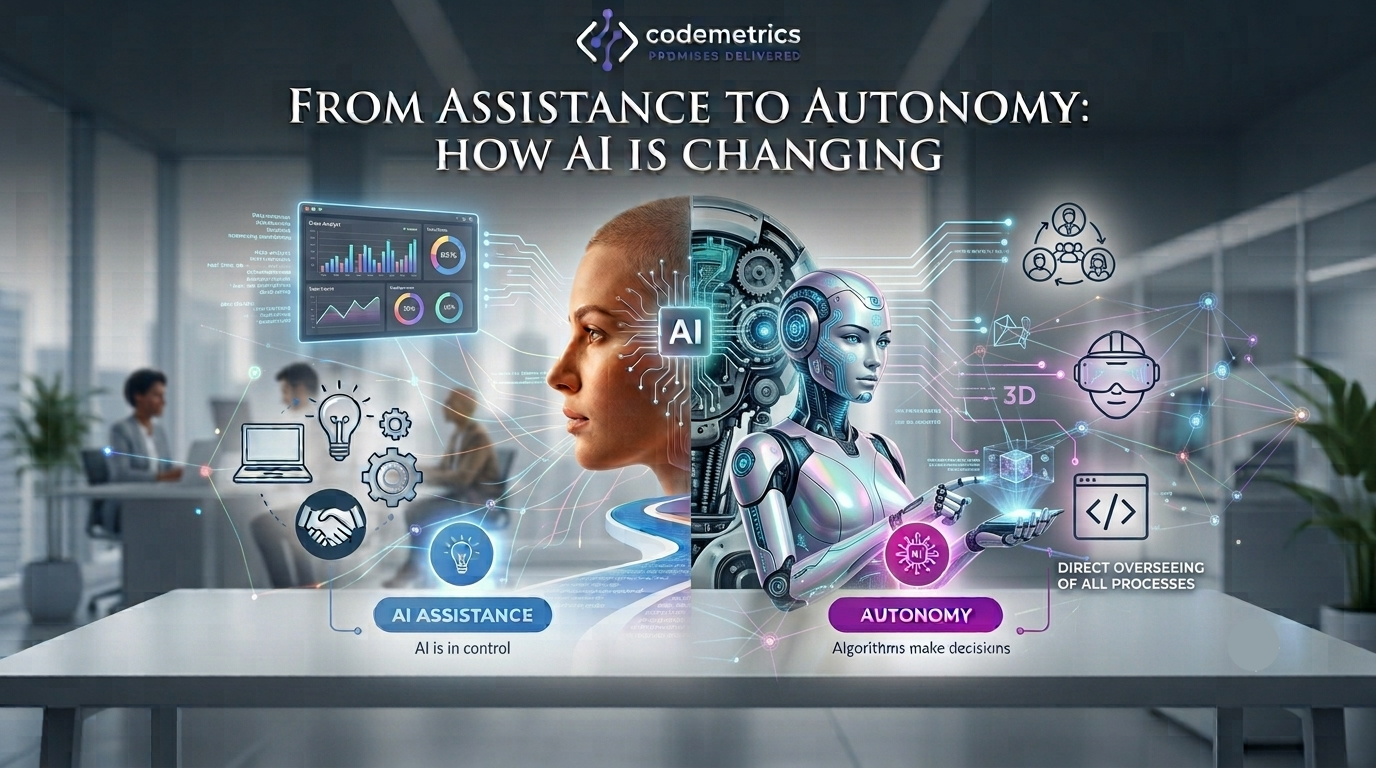
This creates a more useful vision of the future: not humans versus AI, but humans working with AI while clearly defining where machine autonomy ends and human authority begins.
At Codemetrics Infotech Pvt. Ltd., we build AI-powered software solutions today while exploring emerging technologies like Agentic AI to help businesses prepare for the next generation of intelligent, autonomous applications.
Frequently Asked Questions
What is the next generation of AI?
The next generation of AI is increasingly focused on systems that can move beyond generating responses to planning tasks, using tools, maintaining context, making decisions, and executing actions within defined boundaries.
What makes AI agents different from chatbots?
Chatbots primarily respond to user requests. AI agents can be designed to pursue goals through multiple steps, use external tools, maintain task context, and take approved actions.
Can AI make decisions independently?
AI can make decisions within the objectives, information, permissions, and rules provided to it. However, the appropriate level of independence depends on the task and its potential consequences.
Does AI have memory?
AI systems can be designed with different forms of memory, including conversation history, stored information, task state, and external databases. Memory capabilities vary between systems.
What are the risks of autonomous AI?
The risks include incorrect actions, excessive permissions, security vulnerabilities, data exposure, manipulation, unintended consequences, and unclear accountability.
Will AI replace human decision-makers?
AI is likely to automate some decisions and workflows, but high-impact decisions may still require human judgment and accountability. The appropriate balance depends on the specific use case, risk level, and organizational controls.
The Future Is Autonomous—But Not Unaccountable
The evolution of AI is no longer only about creating systems that can generate better content.
It is about creating systems that can understand objectives, plan tasks, use tools, remember context, make decisions, and act.
That creates enormous possibilities for software development, customer service, cybersecurity, marketing, finance, operations, and enterprise automation.
But greater intelligence should not automatically mean greater authority.
The organizations that successfully adopt the next generation of AI will need to think beyond what AI can do.
They will also need to define what AI should do, what it must not do, when it needs approval, and when it should stop.
The future of AI is not simply autonomous intelligence. It is responsible autonomy.
The real opportunity is to build AI that can act intelligently while keeping humans responsible for the decisions that matter most.