Autonomous AI: A New Cybersecurity Frontier
Cybersecurity has traditionally depended on human speed. Security analysts monitor alerts, investigate suspicious activity, analyze logs, patch vulnerabilities, and respond to incidents. But modern digital environments are growing faster and more complex than human teams can monitor manually.
The emergence of autonomous artificial intelligence is changing that equation.
Unlike conventional AI systems that primarily analyze information or provide recommendations, autonomous AI agents can reason through tasks, create plans, use tools, execute actions, and adapt based on changing information. This creates a major opportunity for organizations - but also introduces a new generation of cybersecurity risks.
For businesses, AI cybersecurity is therefore becoming more than a question of detecting attacks. It is increasingly about controlling what intelligent systems can access, what decisions they can make, and how much authority they should receive.
What Is Autonomous AI in Cybersecurity?
Autonomous AI in cybersecurity refers to AI-powered systems capable of performing security-related tasks with limited human intervention.
Instead of simply telling a security analyst that suspicious activity has been detected, an autonomous system could potentially investigate the event, correlate information from multiple sources, identify affected systems, and recommend or perform predefined response actions.
In practical terms, autonomous AI can support activities such as:
Monitoring networks and endpoints
Investigating suspicious behavior
Identifying potential vulnerabilities
Prioritizing security alerts
Automating routine incident response
Testing security configurations
Searching for indicators of compromise
Supporting security operations teams
The important distinction is action.
Traditional AI may answer: “This activity appears suspicious.”
An autonomous system may be designed to continue with: “I found related activity, investigated the affected system, isolated it according to policy, and created an incident report.”
That additional layer of autonomy creates both extraordinary defensive potential and significant operational risk.
Why Is Autonomous AI Important for Cybersecurity?
Modern enterprises operate across cloud infrastructure, SaaS applications, APIs, mobile devices, remote endpoints, databases, and interconnected digital services.
Every additional system creates more security data and more potential attack paths.
Human security teams cannot manually evaluate every event in real time.
Autonomous systems can continuously process large volumes of information and execute predefined workflows at machine speed.
This can help organizations reduce repetitive work while allowing cybersecurity professionals to focus on complex investigations, architecture, risk management, and strategic decisions.
However, speed alone is not security.
A system that can act quickly must also be designed to act safely.
That is where governance becomes critical.
How Can Autonomous AI Improve Cybersecurity?
1. Real-Time Threat Detection and Response
One of the biggest opportunities is the ability to detect and respond to suspicious activity quickly.
AI-powered systems can analyze patterns across logs, endpoints, identities, applications, and network activity. When unusual behavior is detected, automated workflows can potentially investigate the event and initiate predefined defensive actions.
This can reduce the time between detection and response.
Modern AI threat detection can also help security teams prioritize alerts by identifying relationships between seemingly unrelated events.
For example, a single failed login may not appear important. But when the same account shows unusual geographic activity, accesses an unfamiliar system, and downloads an unusually large amount of data, the combined pattern may require immediate investigation.
AI can help connect these signals faster than manual analysis.
2. Automated Security Testing
Autonomous AI can also support continuous security testing.
Instead of relying exclusively on periodic penetration tests, organizations can use automated systems to examine configurations, applications, APIs, and infrastructure for weaknesses.
An autonomous security agent could repeatedly ask:
“What could an attacker potentially exploit in this environment?”
The resulting findings can then be reviewed and prioritized by security professionals.
This approach can help organizations identify configuration mistakes and vulnerabilities earlier in the development and deployment lifecycle.
3. Reducing Repetitive Security Work
Security teams spend significant time performing repetitive activities.
These may include:
Reviewing alerts
Classifying incidents
Collecting logs
Enriching threat intelligence
Checking security configurations
Preparing incident summaries
Performing initial investigations
Automation can handle some of these repetitive processes.
The goal is not necessarily to remove humans from cybersecurity operations.
Instead, autonomous systems can give experienced professionals more time to concentrate on decisions that require context, judgment, and accountability.
What Are the Cybersecurity Risks of Autonomous AI?
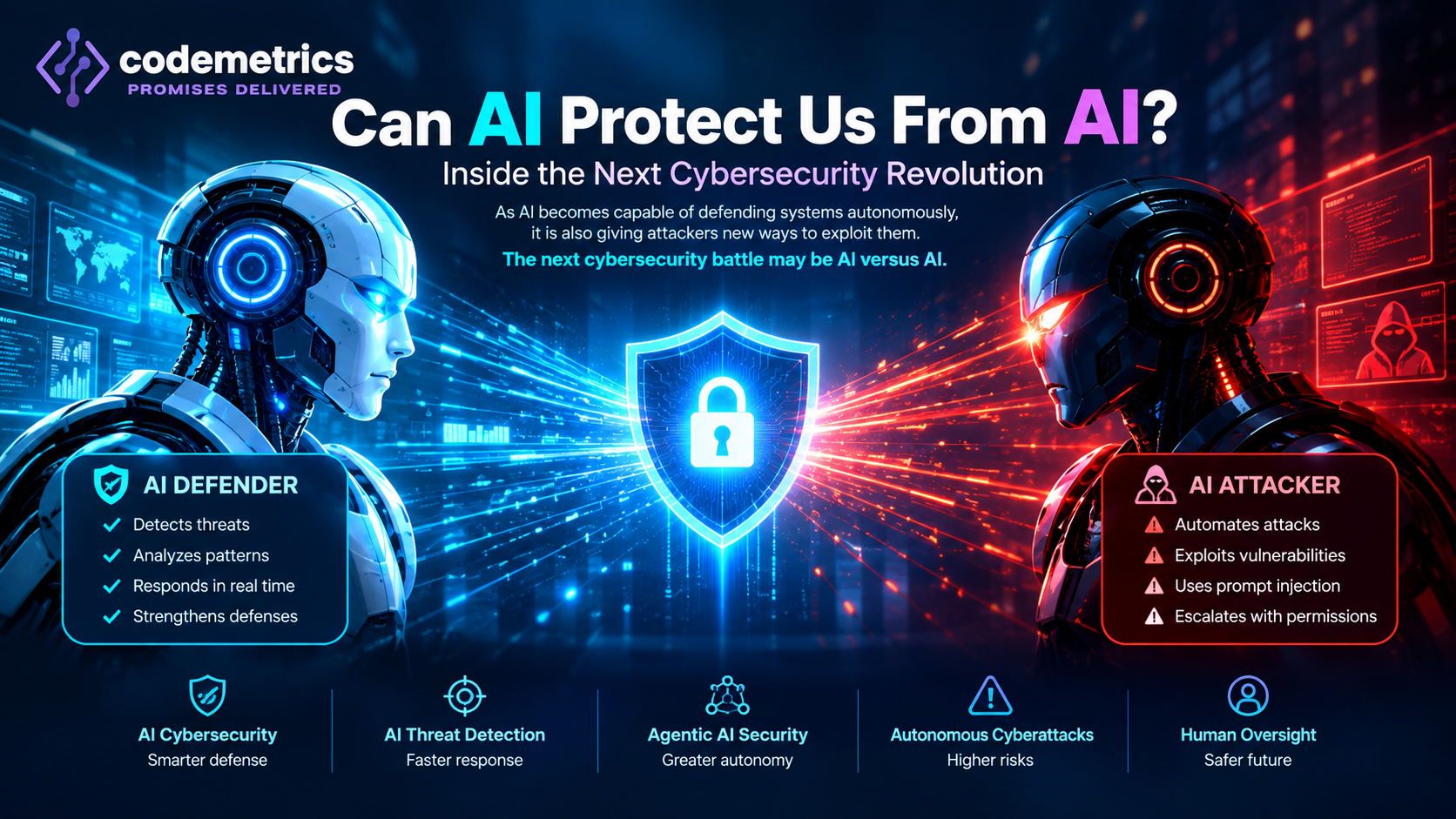
The same capabilities that make autonomous AI useful to defenders can potentially be used by attackers.
This creates a rapidly changing threat landscape.
1. AI-Powered Cyberattacks
Attackers can potentially use AI to accelerate reconnaissance, phishing, vulnerability research, social engineering, and other activities.
Historically, many cyberattacks required significant manual effort. Autonomous systems could reduce the amount of human intervention required for certain stages of an attack.
The concern is therefore not simply that AI can perform malicious actions.
It is that AI can potentially perform them faster, repeatedly, and at greater scale.
This can reduce the time organizations have to identify and respond to an emerging attack.
2. Indirect Prompt Injection
Autonomous AI agents often interact with external information.
They may process emails, websites, documents, support tickets, databases, or other content.
This creates a unique security problem: the information an agent reads may contain instructions that were deliberately created by an attacker.
For example, imagine an AI agent authorized to analyze customer documents.
An attacker embeds malicious instructions inside a document.
When the agent processes that document, it may incorrectly interpret those instructions as part of its operational context.
This is known as indirect prompt injection.
The consequences could include unauthorized data access, inappropriate tool use, or other unintended actions depending on the agent's permissions.
Therefore, agentic AI security must consider not only the AI model but also the information, tools, applications, APIs, and identities connected to the agent.
What Is the "Blast Radius" of an Autonomous AI Agent?
The term blast radius describes the potential extent of damage if a system is compromised or behaves incorrectly.
Consider an autonomous AI agent that has permission to:
Modify cloud infrastructure
Create or delete resources
Access customer information
Execute scripts
Change application configurations
Send external communications
If that agent is compromised, manipulated, or makes an incorrect decision, the consequences could spread rapidly.
The more permissions an agent has, the larger its potential blast radius.
This creates an important cybersecurity principle:
AI autonomy should be matched with appropriate controls and limited permissions.
An agent that only needs to analyze logs should not automatically receive permission to modify production systems.
How Can Businesses Secure Autonomous AI?
Organizations deploying autonomous AI should treat AI agents as operational systems that require security controls, monitoring, and governance.
Least-Privilege Access
AI agents should receive only the permissions required for their specific tasks.
If an agent does not need access to a database, it should not have database permissions.
Human Approval for High-Risk Actions
Not every action should be autonomous.
High-impact activities - such as deleting production data, transferring money, changing critical infrastructure, or exposing sensitive information - should have appropriate human approval mechanisms.
Sandboxing
Agents that need to execute code or interact with potentially risky content can operate inside isolated environments.
Sandboxing can limit what happens if an agent behaves unexpectedly.
Continuous Monitoring
Organizations should monitor autonomous agents just as they monitor other privileged systems.
Security teams should be able to determine:
What the agent accessed
What tools it used
Which actions it performed
What information influenced its decision
What data it transmitted
What changes it made
Strong Identity and Authentication
Every autonomous agent should have an identifiable digital identity.
Organizations need to know which agent performed an action, under which permissions, and at what time.
This creates an auditable trail and helps security teams investigate unusual behavior.
What Is the Role of Humans in Autonomous Cybersecurity?
Autonomous AI does not eliminate the need for human cybersecurity expertise.
In fact, greater autonomy can make human governance even more important.
Humans should define:
Acceptable levels of risk
Permission boundaries
Security policies
Escalation procedures
Approval requirements
Monitoring standards
Incident-response processes
The AI may perform an action, but organizations must remain accountable for the systems they deploy.
This is the foundation of responsible agentic AI security.
The objective should not be to create AI that operates without boundaries.
The objective should be to create AI that is capable, observable, controlled, and accountable.
Autonomous AI and the Future of Cyber Defense
The cybersecurity industry is moving toward a model where humans and intelligent systems work together.
AI can process enormous volumes of information.
It can monitor continuously.
It can identify patterns.
It can automate repetitive security workflows.
It can help security teams investigate incidents faster.
But autonomy introduces a fundamental question:
How much control should an AI system have over the systems it protects?
That question will become increasingly important as businesses connect AI agents to cloud platforms, enterprise applications, databases, development environments, and business processes.
The future of AI cybersecurity will therefore depend not only on building more intelligent systems, but also on building stronger controls around them.
At Codemetrics Infotech Pvt. Ltd., we recognize that the future of AI cybersecurity is not simply about making systems more autonomous - it is about making them more secure, responsible, and controllable. As businesses adopt AI-powered solutions, we focus on building software with security, transparency, scalability, and human oversight at its core. Autonomous AI can create new opportunities for faster threat detection, smarter automation, and resilient digital operations, but its capabilities must always be supported by appropriate safeguards. Codemetrics Infotech Pvt. Ltd. is committed to helping businesses navigate this evolving technology landscape by developing innovative digital solutions designed for a secure, intelligent, and responsible future.