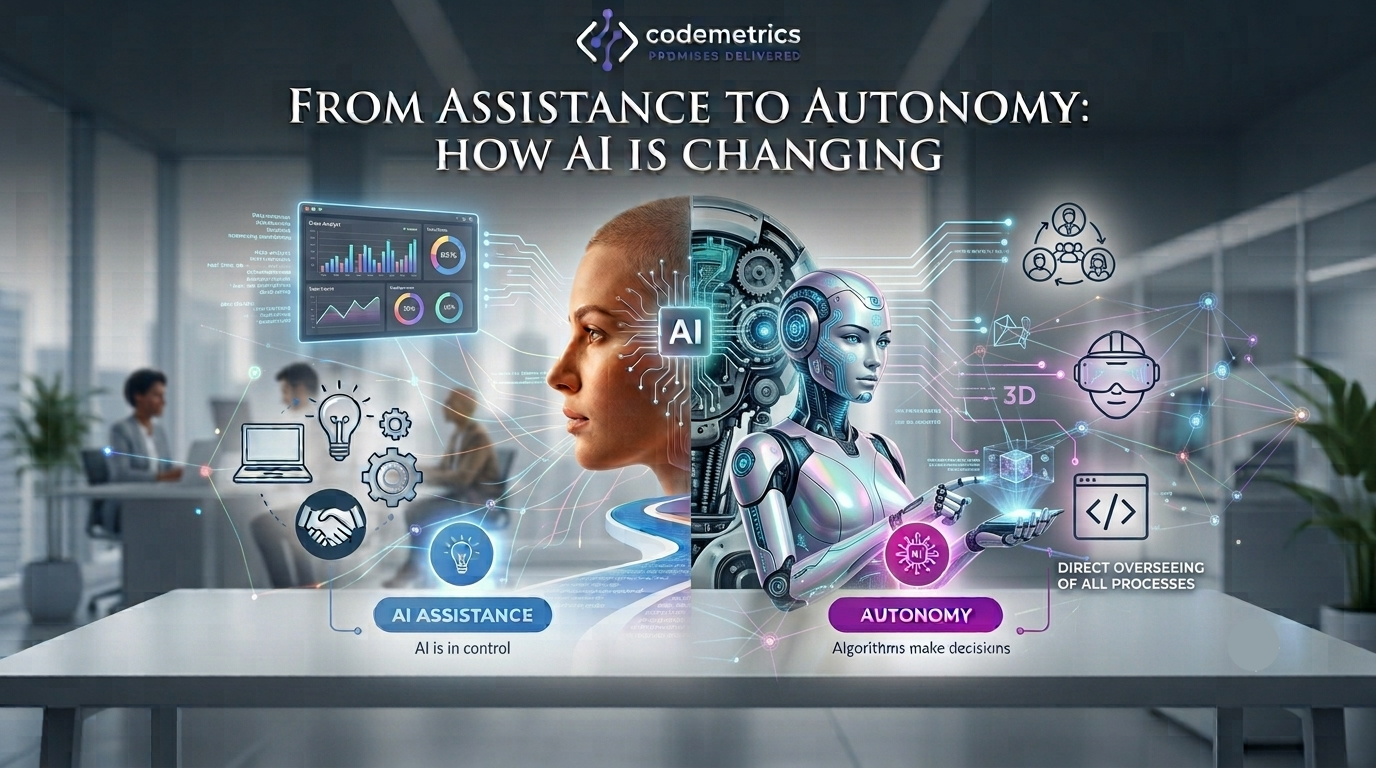
From AI Assistance to AI Autonomy
Artificial intelligence has moved from futuristic technology to an everyday tool. People and businesses now use AI to write content, analyze information, automate workflows, detect patterns, support medical research, forecast demand, and make complex decisions.
But what happens when AI moves beyond assistance and toward autonomy?
The dark side of AI refers to the risks and unintended consequences that can emerge when intelligent systems make increasingly independent decisions. These risks include algorithmic bias, privacy loss, excessive surveillance, human deskilling, unclear accountability, job displacement, and the concentration of technological power.
The key challenge is not simply whether AI can become autonomous. It is whether humans can maintain meaningful oversight, transparency, accountability, and control as AI systems become more capable.
What Is the Dark Side of AI?
The dark side of AI is the collection of social, ethical, economic, privacy, and security risks associated with increasingly powerful artificial intelligence systems.
AI itself is neither inherently beneficial nor harmful. Its impact depends on how systems are designed, trained, deployed, monitored, and governed.
As AI takes on more responsibility, the consequences of errors can also become more significant. An AI assistant that generates an inaccurate email may create inconvenience. An automated system involved in hiring, financial decisions, healthcare, transportation, or security can potentially create much greater consequences.
This shift makes responsible development increasingly important.
1. Algorithmic Bias: When AI Reproduces Human Inequality
One of the most important AI risks is algorithmic bias.
AI models learn patterns from data. If historical data contains social inequalities, incomplete representation, or discriminatory patterns, an AI system can reproduce or amplify those patterns.
For example, an AI system used to screen job applications may learn from historical hiring data. If previous hiring decisions reflected biased patterns, the system could potentially favor similar profiles rather than objectively evaluating every applicant.
The same concern can arise in areas such as:
Recruitment and employee screening
Credit and financial services
Facial recognition
Insurance
Healthcare
Education
Public-sector decision-making
The danger is amplified when automated decisions appear objective simply because they are produced by software.
How can AI bias be reduced?
Organizations can reduce potential bias through representative training data, independent testing, continuous monitoring, documented evaluation criteria, human review, and clear processes for challenging automated decisions.
AI should assist decision-making without becoming an unquestionable authority.
2. Privacy and the Rise of AI-Powered Surveillance
Advanced AI systems depend heavily on data.
The more information an AI system can access, the more accurately it may be able to identify patterns, personalize experiences, or predict behavior. However, extensive data collection creates serious privacy questions.
Modern digital ecosystems can collect information about browsing activity, purchases, locations, interactions, preferences, images, and other forms of digital behavior.
AI can then process enormous quantities of this information at a speed humans cannot match.
Why is AI a privacy concern?
AI creates privacy concerns because large datasets can contain sensitive personal information, while automated analysis can reveal patterns that individuals may not realize they are sharing.
Two major concerns stand out:
Data vulnerability:
Large collections of personal information can become attractive targets for cyberattacks, unauthorized access, or accidental exposure.
Behavioral profiling:
AI can analyze digital behavior to predict interests, preferences, and likely actions. This raises questions about how much influence technology should have over individual choices.
Privacy therefore needs to be considered during AI design rather than treated as an afterthought.
3. Human Agency and the Risk of Deskilling
Another important aspect of the dark side of AI is the possibility of excessive dependence.
When AI consistently performs difficult cognitive tasks, people may gradually stop practicing those skills themselves.
Consider navigation. GPS systems make travel easier, but people may become less familiar with routes and directions. Similarly, if AI routinely writes, researches, analyzes, codes, or makes recommendations, users may become less comfortable performing those tasks independently.
This creates a potential deskilling problem.
The issue is not that automation is inherently negative. Automation can remove repetitive work and allow people to focus on higher-value activities. The concern arises when humans lose the ability to understand, verify, or intervene in important processes.
Why does human oversight matter?
Human oversight provides a critical layer of judgment when AI produces inaccurate, unexpected, or contextually inappropriate results.
For high-impact applications, people should understand:
What the AI system is designed to do
What data it uses
What its limitations are
When its recommendations should be questioned
Who is responsible when something goes wrong
The objective should be human-AI collaboration, not blind dependence.
4. AI and Job Displacement
AI is also changing the nature of work.
Earlier waves of automation were strongly associated with physical and repetitive tasks. Modern AI can increasingly perform or support cognitive activities such as writing, coding, image generation, data analysis, customer service, research, and administrative work.
This creates both opportunities and uncertainty for workers.
Some jobs may change rather than disappear. Other roles may experience significant automation. New occupations may also emerge around AI development, implementation, auditing, security, governance, and human-AI collaboration.
The challenge is ensuring that workers can adapt to these changes.
How can businesses respond to AI-driven workplace change?
Organizations can focus on reskilling, upskilling, responsible automation, redesigned workflows, and transparent communication with employees.
Rather than viewing AI only as a replacement for people, businesses can use it to automate repetitive activities while allowing employees to concentrate on creativity, relationships, strategy, problem-solving, and other areas where human judgment remains valuable.
5. The Hidden Human Labor Behind AI
AI can appear completely automated to the end user, but many AI systems depend on human labor behind the scenes.
People may be involved in collecting and labeling training data, evaluating AI responses, moderating harmful material, testing systems, and improving model performance.
Some of this work can involve repetitive or psychologically difficult tasks.
This creates an important question: Who is responsible for the human conditions behind AI development?
Responsible AI should therefore consider not only the person using an AI product but also the workers involved throughout the technology's development and operation.
6. The Black-Box Problem and Accountability
Some AI systems are difficult to interpret, especially when complex models produce results that cannot easily be explained in human terms.
This creates a potential accountability problem.
If an AI system makes an incorrect recommendation, several questions immediately arise:
Who made the decision?
Who designed the system?
Who supplied the data?
Who approved its use?
Who is responsible for correcting the outcome?
These questions become increasingly important as organizations use AI in high-impact environments.
AI systems should therefore be accompanied by appropriate documentation, testing, monitoring, access controls, and accountability mechanisms.
How Can We Build Responsible AI?
The answer is not to reject AI altogether. Instead, society and organizations need approaches that balance innovation with responsible deployment.
Several principles can help:
1. Keep Humans in the Loop
Important decisions should have appropriate human oversight, particularly when mistakes could significantly affect individuals.
2. Improve Transparency
Users should understand when they are interacting with AI and, where appropriate, how automated decisions are made.
3. Protect Personal Data
Organizations should minimize unnecessary data collection and establish appropriate security and privacy controls.
4. Test for Bias
AI systems should be evaluated across relevant populations and use cases before and after deployment.
5. Monitor AI Continuously
AI performance can change as data, users, and environments change. Continuous evaluation is therefore important.
6. Prepare People for Change
Businesses should invest in training and help employees develop skills that complement AI.
7. Establish Clear Accountability
Organizations should define who is responsible for AI systems, their outputs, monitoring, and corrective action.
Assistance vs. Autonomy: Where Should AI Stop?
The transition from AI assistance to autonomy should not be viewed as a simple technological upgrade.
An AI assistant generally supports a human decision-maker. An autonomous system may execute actions with limited human intervention.
That distinction matters.
For low-risk tasks, greater automation may provide significant efficiency benefits. For high-impact decisions, organizations may require stronger safeguards, human review, auditability, and clearly defined intervention mechanisms.
The right level of autonomy should therefore depend on the risk, context, consequences, and reversibility of the decision.
How Can Everyday Users Protect Their Privacy From AI Tracking?
Everyday users can take several practical steps to reduce unnecessary data exposure:
Review privacy settings on social media and mobile applications.
Limit unnecessary app permissions, especially location, microphone, contacts, and camera access.
Use strong, unique passwords and multifactor authentication.
Keep browsers, operating systems, and applications updated.
Avoid entering highly sensitive personal information into AI tools unless necessary.
Check what information an AI service stores and how it may be used.
Disable personalized advertising or tracking options where available.
Be cautious when granting third-party applications access to personal accounts.
Regularly review connected apps and revoke permissions that are no longer needed.
Use privacy-focused browser and search settings where appropriate.
Privacy protection does not require avoiding technology completely. It requires understanding what information is being collected, why it is being collected, and who may have access to it.
At Codemetrics Infotech Pvt. Ltd., we help businesses harness the power of AI through innovative, scalable, and responsible technology solutions designed to create lasting business value.As AI evolves from simply answering prompts to taking autonomous actions, businesses can unlock faster workflows, smarter decision-making, and greater operational efficiency. Codemetrics Infotech Pvt. Ltd. helps organizations turn this evolution into practical business solutions by developing AI-powered applications, intelligent automation, custom software, cloud solutions, and secure API integrations. From automating repetitive tasks to building AI systems that can plan, execute, monitor, and adapt, Codemetrics helps businesses adopt autonomous AI with the right balance of innovation, security, human oversight, and scalability. Ready to move beyond AI conversations and build AI that takes meaningful action? Connect with Codemetrics Infotech Pvt. Ltd. to explore the right solution for your business.
The Future of AI Should Be Human-Centered
The dark side of AI is ultimately a reminder that technological capability and responsible deployment are two different things.
AI can automate repetitive work, support scientific discovery, improve productivity, assist professionals, and create new possibilities. At the same time, poorly designed or poorly governed systems can introduce bias, privacy concerns, economic disruption, and accountability challenges.
The goal should not simply be to create increasingly autonomous machines.
The more important goal is to build AI systems that remain aligned with human values, provide appropriate transparency, protect privacy, and preserve meaningful human control.
As AI moves from assistance toward autonomy, the central question should not be “How much can AI do without humans?”
It should be:
“How can humans use AI's increasing capabilities while keeping people informed, empowered, and accountable?”
That question will shape the next phase of artificial intelligence.