What Is AI-Powered Business Intelligence?
Businesses generate large volumes of data through sales transactions, customer interactions, financial records, inventory systems, and operational activities. Turning this information into useful insights is essential for making informed business decisions. However, collecting and analyzing data from multiple sources can be time-consuming when processes rely heavily on manual reporting.
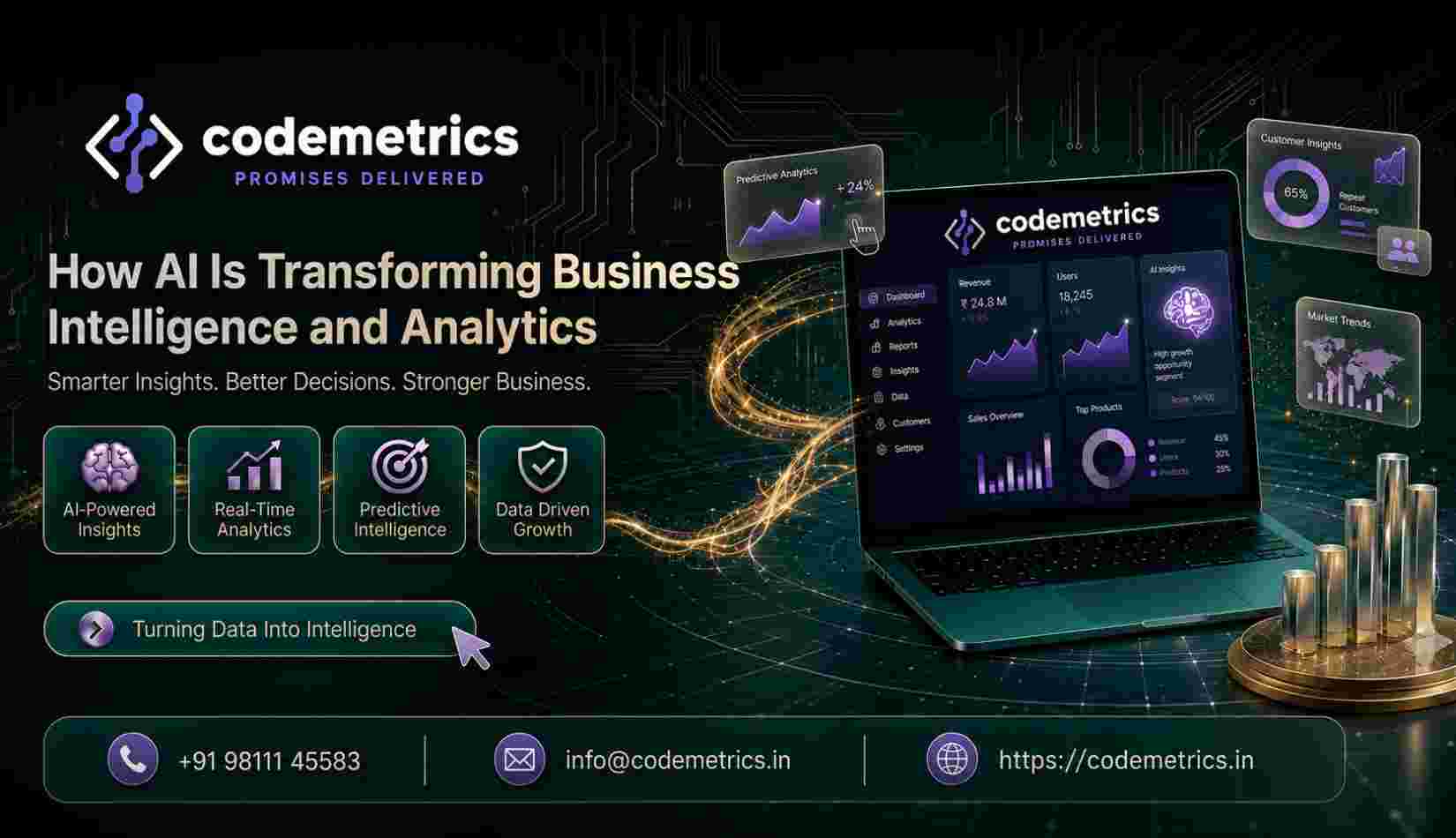
AI in Business Intelligence combines artificial intelligence techniques, machine learning, and data analytics to help organizations interpret business information more efficiently. These capabilities can support forecasting, identify unusual patterns, automate selected reporting tasks, and help decision-makers explore complex datasets.
Traditional business intelligence systems primarily focus on organizing historical information into reports, charts, and dashboards. AI-enhanced systems can extend these capabilities by identifying patterns, generating predictions, and summarizing findings. The results depend on the quality of the underlying data, the suitability of the analytical models, and the context in which insights are used.
For businesses, the objective is not simply to introduce AI into existing workflows. It is to make relevant information more accessible, improve analysis, and support better-informed decisions while maintaining appropriate human oversight.
How AI Improves Business Analytics
Faster Data Analysis
Analyzing information from multiple business systems can require considerable time and coordination. AI-assisted analytics can help classify information, identify relationships, summarize datasets, and support repetitive analytical tasks.
For example, a sales team may need to compare revenue across products, regions, and sales channels. An analytics platform can help organize these dimensions and highlight changes that deserve further investigation.
Business analytics solutions that incorporate AI may also help users explore large datasets without manually preparing every report. Nevertheless, organizations should validate calculations, data definitions, and analytical outputs before using them for important decisions.
Forecasting and Trend Identification
Forecasting helps businesses estimate future demand, revenue, resource requirements, and other operational measures. Machine learning models can analyze historical observations alongside relevant factors to identify patterns and generate forecasts.
Consider a retailer preparing for a seasonal sales period. Its analytics system could examine historical sales, product availability, promotional activity, and seasonal patterns to estimate future demand. Managers could use these estimates to review purchasing plans and inventory levels.
Similarly, a finance team might use forecasting models to examine expected cash flow based on historical transactions and planned business activities.
Predictive analytics software can support these processes, but forecasts are estimates rather than guarantees. Unexpected market changes, incomplete data, and shifts in customer behavior can affect their reliability. Businesses should compare forecasts with actual results and update models when conditions change.
Anomaly Detection
Anomaly detection identifies observations that differ significantly from expected patterns. It can help organizations investigate unusual transactions, unexpected cost increases, sudden sales changes, and operational disruptions.
For example, an expense monitoring system might flag a department whose spending rises well above its usual range. A financial analytics platform might identify an unusual transaction for additional review, while an inventory system could highlight stock movements that do not match expected activity.
AI-powered anomaly detection can help prioritize investigations, but an unusual observation is not necessarily evidence of fraud or misconduct. Thresholds, business rules, and human investigation are important for distinguishing genuine problems from legitimate exceptions.
Natural-Language Queries and Summaries
Some modern analytics platforms allow users to ask questions about business information in natural language. Instead of manually navigating multiple reports, a manager might ask, “Which product categories experienced the largest sales decline last quarter?”
Depending on the platform, the system may translate the question into a database query, retrieve relevant information, and present the results in a chart or written summary.
AI can also assist with preparing management summaries, explaining changes in key performance indicators, and identifying questions for further investigation.
These features should be used carefully. Natural-language systems can misunderstand questions, use incorrect metric definitions, or produce summaries that do not accurately reflect the source data. Users should be able to inspect the underlying figures and verify important conclusions.
Practical Business Use Cases
AI-assisted business intelligence can support different functions across an organization. The most appropriate applications depend on available data, business objectives, and the consequences of an incorrect result.
Sales and Revenue Forecasting
Sales teams can analyze historical revenue, product performance, customer segments, and seasonal changes to estimate future sales. These insights can inform sales planning, target setting, and resource allocation.
For instance, a business selling products through several channels could compare demand patterns across online and offline sales to identify areas requiring further attention.
Inventory and Supply Chain Planning
Retailers and manufacturers can use analytical models to estimate demand, identify unusual stock movements, and monitor supplier performance.
A system might flag products with unexpectedly high demand or identify a potential inventory shortage based on current stock and recent sales. Staff can then verify the situation before adjusting purchasing or distribution plans.
Financial Monitoring and Risk Analysis
Finance teams can use AI-assisted analytics to identify unusual expenses, monitor cash flow, compare budgeted and actual spending, and highlight transactions that require review.
A sudden increase in operating costs, for example, could trigger an alert for investigation. The alert can help direct attention to the relevant records without automatically assuming that an error has occurred.
Customer Behavior Analysis
Organizations can analyze purchasing patterns, service interactions, and engagement data to understand customer needs more effectively.
An analytics platform might identify changes in repeat purchases or show which customer groups are engaging less frequently. Marketing and customer service teams can use these findings to evaluate communication strategies and improve service planning.
Customer analysis should respect applicable privacy requirements and avoid collecting or using personal information without an appropriate basis.
Operational Performance Monitoring
Businesses can track indicators such as order processing time, delivery delays, service response times, production output, and resource utilization.
AI-assisted monitoring may highlight deviations from expected performance and help managers investigate potential causes. This can be particularly useful when information is distributed across multiple operational systems.
These examples demonstrate possible applications rather than guaranteed results. Their effectiveness depends on the relevance of the data, the accuracy of the analysis, and how teams act on the information.
Data Quality, Privacy and Human Review
AI analytics is only as reliable as the data and processes supporting it. Before implementing an AI-enabled reporting or forecasting system, businesses should establish clear standards for data management and responsible use.
Maintain Reliable Data
Incomplete records, duplicated entries, inconsistent date formats, outdated information, and incorrect metric definitions can lead to misleading insights.
Organizations should establish processes for validating incoming data, resolving inconsistencies, documenting data sources, and monitoring data freshness. Teams should also agree on standard definitions for measures such as revenue, profit, active customers, and operating costs.
When different systems calculate the same metric differently, the resulting analysis may be confusing even if the AI model functions as intended.
Protect Privacy and Control Access
Business datasets may contain customer details, employee records, financial information, and confidential operational data. Organizations should identify which information an analytics system needs and restrict access according to users' responsibilities.
Appropriate safeguards may include role-based permissions, encryption where applicable, secure integrations, retention policies, audit logs, and controls over external AI services.
Businesses should assess how a vendor stores, processes, and uses submitted data before integrating sensitive information into an AI-powered platform. Applicable privacy laws, contractual obligations, and industry requirements must also be considered.
Keep Human Review in the Decision Process
AI-generated insights should inform decisions rather than automatically replace professional judgment in every situation.
For example, a forecast may indicate a potential cash-flow shortage, but a finance manager should review planned payments, confirmed receivables, and other relevant circumstances before changing financial plans.
Similarly, an anomaly alert should trigger investigation rather than an automatic conclusion that a transaction is fraudulent.
Human review is especially important for high-impact decisions, uncertain predictions, and situations where incorrect conclusions could cause financial, operational, or reputational harm.
Monitor Model Performance
Business conditions change over time, and analytical models may become less reliable when the data they receive differs from the data used during development.
Organizations should compare predictions with actual outcomes, monitor false alerts and missed anomalies, and reassess model performance periodically. Documenting model limitations and assigning responsibility for review can help maintain trust in the results.
Evaluating an AI Analytics Solution
Choosing an AI analytics platform requires more than comparing the number of features available. Businesses should evaluate how well a solution addresses their actual reporting and decision-making requirements.
Define Business Objectives
Start by identifying the problem to solve. Examples include reducing the time required to prepare reports, improving demand forecasts, identifying unusual expenditure, or consolidating information from different departments.
Each objective should have a clear baseline and an appropriate way to measure progress.
Review Data Sources and Integration
Determine whether the solution can work with the organization's existing databases, spreadsheets, CRM platforms, ERP systems, financial applications, and other relevant sources.
Review data compatibility, integration costs, update frequency, access permissions, and the effort required to maintain connections between systems.
Assess Analytical Capabilities
Evaluate whether the platform supports the required reporting, forecasting, anomaly detection, visualization, and natural-language features.
Ask how it explains results, handles missing data, communicates uncertainty, and enables users to verify the figures behind an insight. Capabilities should be tested using representative business data before making a commitment.
Evaluate Security and Governance
Review authentication, authorization, encryption, auditability, data retention, vendor data usage, and available administrative controls.
Organizations should also clarify who is responsible for maintaining the system, reviewing its outputs, and addressing incorrect or unexpected results.
Consider Total Cost and Ongoing Support
The total cost of an analytics solution may include software subscriptions, infrastructure, data preparation, integration, implementation, employee training, and ongoing maintenance.
A pilot project can help establish whether the proposed solution meets business requirements before the organization expands its use. Results should be measured against the original objectives rather than relying only on vendor claims.
How Codemetrics Can Help
Codemetrics Infotech Pvt. Ltd. provides software and digital technology services. Businesses exploring AI-assisted analytics can begin by defining their data sources, reporting challenges, integration requirements, and operational objectives.
Depending on the agreed project scope and available capabilities, a business intelligence initiative may involve connecting existing systems, organizing business data, developing application interfaces, or evaluating appropriate analytical technologies.
Before proceeding, organizations should clarify the proposed features, technology choices, data access requirements, security responsibilities, implementation milestones, and ongoing support arrangements.
To learn more about Codemetrics, visit the official website. Relevant links to verified software development services or documented case studies should be added to this article once their exact public URLs and relevance have been confirmed.
Conclusion
AI is expanding the capabilities of business intelligence by helping organizations analyze information, generate forecasts, identify anomalies, and explore business performance more efficiently. These capabilities can support decisions across sales, finance, inventory management, customer service, and operational planning.
However, useful analytics requires more than sophisticated algorithms. Reliable data, suitable integrations, privacy safeguards, model monitoring, and human review are essential for interpreting results responsibly.
Businesses should begin with clearly defined objectives, evaluate solutions using representative data, and measure performance against practical requirements. By combining AI-assisted analysis with sound data governance and informed human judgment, organizations can build a more reliable foundation for data-driven decision-making.