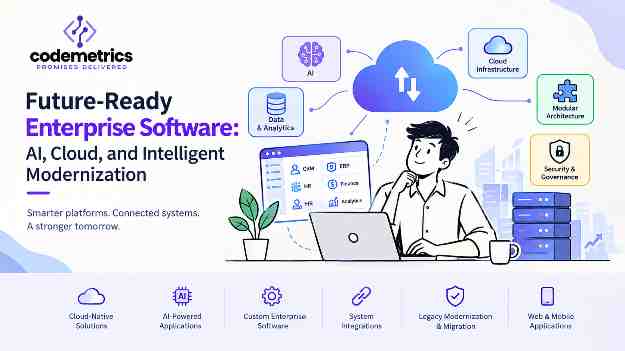
Future-Ready Enterprise Software: AI, Cloud, and Intelligent Modernization
Enterprise software is entering a new phase. Organizations are no longer investing in large applications simply to replace spreadsheets or digitize old workflows. They are looking for intelligent, connected, scalable platforms that can respond to changing customers, markets, regulations, and operating models. This shift is creating a new approach to enterprise technology: software is becoming a strategic business capability rather than an internal IT tool.
The most important question for business leaders is no longer whether they should modernize their software, but how they can build an architecture that remains useful five or ten years from now. The answer lies in combining modular enterprise applications, cloud-native infrastructure, AI, automation, data platforms, and seamless integration.
Why Enterprise Software Is Becoming a Business Strategy
Modern enterprises operate across departments, locations, applications, and data sources. Sales may use a CRM, finance may depend on an ERP, operations may use specialized platforms, and customer service may work from another system. When these technologies operate independently, businesses create data silos, duplicate processes, and visibility gaps.
A modern enterprise software strategy connects these functions around shared business objectives. Instead of creating another isolated application, technology teams can build platforms that exchange data, automate workflows, and provide decision-makers with a unified view of operations.
This is why companies increasingly evaluate top enterprise software development companies based on their ability to understand business processes, architecture, security, scalability, and long-term product strategy—not simply their coding capabilities.
The Rise of Composable Enterprise Architecture
One of the biggest changes in enterprise development is the move from monolithic applications toward modular and composable architectures. Businesses want software that can evolve without requiring a complete rebuild every time a process changes.
A modular architecture separates major capabilities into manageable services or components. Organizations can then update one part of a platform without disrupting the entire system. APIs, microservices, reusable components, and cloud infrastructure make this approach practical for growing enterprises.
Composable architecture also supports faster experimentation. A business can introduce a new customer portal, analytics module, workflow engine, or AI capability without redesigning every existing application.
For enterprises planning long-term technology investments, evaluating top enterprise software development companies should therefore include their approach to cloud architecture, modular development, APIs, scalability, security, and continuous improvement.
AI Is Becoming Part of the Software Architecture
Artificial intelligence is moving beyond standalone chatbots and experiments. Enterprise applications are increasingly being designed with AI capabilities built directly into workflows.
AI can support forecasting, document processing, customer service, fraud detection, recommendations, knowledge search, quality monitoring, and decision support. When AI is connected to enterprise data and business processes, it can deliver much more value than a generic tool operating outside the organization.
This is also changing AI product engineering. Instead of treating AI as a separate feature added at the end of development, product teams can consider data pipelines, model evaluation, security, human oversight, and user experience from the beginning.
For example, an enterprise procurement platform could use AI to identify unusual purchasing patterns, summarize supplier documents, and recommend actions. A service-management platform could analyze historical tickets and suggest resolutions before an issue escalates.
As AI becomes embedded into enterprise workflows, AI product engineering will increasingly require collaboration between software developers, data teams, product managers, security specialists, and business stakeholders.
Modernization Without Disrupting the Business
Many enterprises face a difficult challenge: their existing software still supports critical operations, but it is expensive to maintain, difficult to integrate, or unable to support modern customer expectations.
The answer is not always to replace everything at once. Legacy application modernization can provide a structured path forward. Organizations can identify critical workloads, improve their architecture, expose existing functionality through APIs, migrate selected components to the cloud, and gradually replace outdated modules.
A phased approach reduces operational risk. It also allows organizations to measure business value before expanding modernization programs. In many cases, the most practical strategy is to keep stable core systems while modernizing the parts that create the greatest business bottlenecks.
A successful legacy application modernization strategy should therefore begin with application discovery, dependency mapping, security assessment, business-priority analysis, and a clear migration roadmap rather than an immediate technology replacement.
The Integration Layer Will Become More Important
Enterprise transformation cannot succeed when applications remain disconnected. Enterprise system integrations are therefore becoming a central part of software architecture.
Integration can connect CRM, ERP, HRMS, payment platforms, analytics tools, customer portals, third-party services, and internal applications. APIs and event-driven architectures can allow systems to exchange information in near real time.
For example, when a customer completes an online purchase, an integrated architecture can automatically update inventory, trigger payment processing, create an order in the ERP, update the CRM, and send the customer a notification. This removes repetitive data entry and creates a smoother customer experience.
As organizations add more SaaS applications and specialized business platforms, enterprise system integrations will become essential for maintaining a consistent flow of data across the organization.
Security and Governance Must Be Built In
As enterprise software becomes more connected and intelligent, security cannot be treated as a final development step. Identity management, access controls, encryption, monitoring, audit trails, secure APIs, data governance, and compliance requirements should be considered throughout the architecture.
AI introduces additional responsibilities. Enterprises must understand where sensitive data is processed, how models access information, how outputs are evaluated, and where human approval is required.
A strong enterprise platform therefore balances innovation with governance. The goal is not simply to deploy more technology, but to create systems that employees and customers can trust.
What Businesses Should Look for in a Technology Partner
Choosing a technology partner requires more than comparing development rates. Enterprises should evaluate whether a provider can understand business requirements and translate them into a scalable technology roadmap.
The right partner should demonstrate experience across architecture, cloud platforms, application development, integrations, security, DevOps, testing, and ongoing support. It should also be capable of working with existing systems rather than assuming every organization can start from scratch.
Strong enterprise software development services should cover the complete lifecycle—from discovery and architecture to development, testing, deployment, optimization, and maintenance. A long-term partner should also help the business prioritize modernization initiatives according to measurable outcomes.
The best enterprise software development services combine technical expertise with business understanding. This enables organizations to build software around actual operational requirements instead of simply adding technology for the sake of innovation.
The Future: Intelligent, Connected and Continuously Evolving
The future of enterprise technology will not be defined by one programming language, cloud provider, or AI model. It will be defined by how effectively organizations connect people, processes, data, and technology.
Businesses will increasingly adopt intelligent applications that learn from operational data, automate routine decisions, personalize experiences, and provide real-time insights. At the same time, modular architectures will allow these capabilities to evolve without forcing organizations into expensive full-system replacements.
This means the next generation of enterprise platforms will need to be flexible by design. They will combine cloud scalability, AI intelligence, secure integrations, automation, analytics, and human decision-making into a connected digital ecosystem.
The companies that succeed will be those that treat software as an evolving business platform rather than a one-time IT project.
Codemetrics Infotech Pvt. Ltd.: Building Future-Ready Enterprise Software
Codemetrics Infotech Pvt. Ltd. helps businesses turn complex technology requirements into scalable digital solutions. As an enterprise technology partner, the company focuses on custom software, AI-powered applications, cloud solutions, SaaS platforms, web and mobile applications, and DevOps capabilities.
Codemetrics approaches enterprise transformation with a practical focus on business outcomes, scalability, security, and long-term maintainability. From modern application development to system integration and modernization initiatives, its solutions are designed to help organizations reduce operational complexity and build connected digital ecosystems.
For businesses planning their next stage of technology growth, Codemetrics Infotech Pvt. Ltd. can help design and develop future-ready software that connects people, processes, data, and intelligent technologies.